
Do you have a defined customer follow-up process? Have you thought about whether these actions are influencing the number of conversions?
Customer follow-up is one of the most decisive stages in the sales process and it is often believed that a simple call, email or WhatsApp is enough.
This is not just about sending a message after the first consultation, but about building a relationship that generates trust, loyalty… in order to achieve more sales every day.
So now I ask you again…do you think you have a defined customer follow-up process? If your answer is no…great, then this post is for you.
Subscribe to Clientify’s blog
Do you like marketing, automation or just seeing how other people do things right? Then subscribe.
Every week we send you what we would like to receive: direct and actionable content.
What is customer follow-up and why is it key to your sales?
Customer follow-up is the process of accompanying a person from the moment they contact you for the first time until long after the sale has been made.
But as we said before, it does not mean sending a single message or bombarding the contact with emails or calls. A good customer follow-up is achieved when you maintain a constant communication, with purpose and that provides value in each interaction.
Think about how important follow-up is at every stage of your commercial process: in pre-sales, follow-up allows you to build trust and show that you are present without being invasive. During negotiation, it helps you to maintain active interest and resolve doubts as they arise. And in post-sales, follow-up is key to building loyalty, getting referrals and new opportunities.
Therefore, when you have a well-structured follow-up process, it is reflected in your results. Keep in mind that a constant and correctly planned follow-up is what improves retention, accelerates repurchase and increases the chances of cross-selling.
And let alone if you do this customer follow-up from a CRM…the more organized and personalized your follow-up is, I assure you that your sales will grow.
How to adapt your follow-up to each customer’s moment?
Each customer experiences a different moment in your commercial process, and your way of communicating must adapt to that. It’s not about following a formula, but about understanding what they need at each stage and how to best support them.
When a lead is new, the first contact has to be super fast: the sooner you respond, the more likely you are to capture their attention.
Now, you don’t want to rush through the negotiation stage. This is a phase where the pace is more leisurely and strategic; where you should provide value and not pressure.
And keep in mind that after a meeting or consultation, it is best to follow up within 48 hours to reinforce the key points and propose the next step… always taking into account what the client has told you during the conversation.
On the other hand, whenever you send a proposal or quote, it is best to wait a few days to get back in touch. Here the important thing is to show the lead a genuine interest in solving your problem.
This way, when the time comes to close the deal, the customer will continue to see that accompaniment and not the urgency and pressure to be just another sale.
And it is precisely in the onboarding and loyalty stage that you have the opportunity to shine: show the customer that you are there to help him, always maintaining a natural conversation and showing him that, even if he has already bought, he is still as important to your company as he was from day one.
There is no universal rule about following up with clients…but from experience, let me give you some advice: responding in less than 24 hours builds trust, resuming the conversation after three or four days makes you seem less pushy, and keeping communication light every two to three weeks helps you not to be forgotten.
Remember that the most important thing in this process is to provide value with a new idea, a recommendation or a concrete solution.
| Stage of the commercial process | Objective of monitoring | Recommended type of communication |
| Lead new | Capture their attention and generate a positive first impression. | Brief and personalized message showing interest and immediate availability. |
| Negotiation | Accompany the customer without pressuring and provide value to maintain interest. | Strategic communication with useful content: cases, ideas, resources or solutions. |
| Post-meeting or consultation | Reinforce the points discussed and define the next step. | Follow-up message with brief summary, thank you and clear next action. |
| Proposal or quotation sent | Show genuine interest without commercial urgency. | Friendly message, focused on resolving doubts or adjusting the proposal according to needs. |
| Closing | Maintain the accompaniment and generate final trust. | Clear communication, with a collaborative attitude and no pressure. |
| Onboarding | Guide the customer in their first steps and ensure a good experience. | Proactive welcome message, support and resources to get started. |
| Loyalty | Maintain relationships and detect new opportunities. | Natural conversation with valuable content, news or recommendations. |
Which channel to use at each stage of monitoring?
Now that you know what the objective of each follow-up is, it is time to define which communication channel you are going to use.
But as each customer has its own preferred channel, the ideal is to choose the channel that best suits the phase of your commercial process:
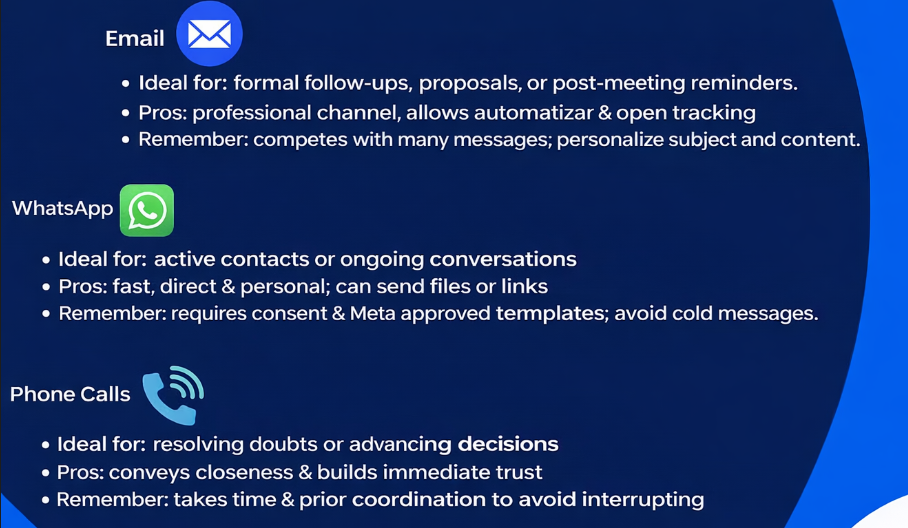
Email:
You already know that email is still the most professional channel when it comes to keeping in touch with your clients. It allows you to develop an idea, share documents and maintain a more detailed communication with the client, without the time pressure.
Ideal for follow-up, sending proposals or reinforcing key information after a meeting.
The good thing is that some CRMs like Clientify allow you to link your email and then create automated email flows and measure opens or clicks to know who shows more interest.
However, the downside of this channel is that it competes with dozens of messages in the inbox and can go extremely unnoticed. Therefore, the key is to personalize the subject and content and avoid sending generic templates.
WhatsApp:
Yes, WhatsApp is the most used channel of the moment. It is direct and personal; and that is why you have to be very delicate when sending these messages.
A short, friendly message with a human touch definitely makes a difference and makes the conversation flow super naturally. You can share catalogs, documents or links without leaving the chat.
But remember that META sets certain limits when sending messages via WhatsApp. That is why it is important to ask for consent and to maintain a balance between agility and respect for the client’s space.
Pro tip: use a CRM with WhatsApp only when there is already a relationship or active interest, never as a first cold contact.
Calls:
When you need to advance a decision or resolve an important question…don’t hesitate to make a call.
Greet with closeness, remember the context and comment clearly what the next action is. The ideal is to have a flexible script, but not to read it by heart, but to keep the focus on the essentials.
Think about how close and confident the person feels when listening to your voice… but be careful, because this call requires more time. That’s why the ideal is to coordinate the call with a previous message so as not to interrupt at an inopportune moment and not be able to connect.
5 key steps in customer follow-up
For your customer follow-up process to really work, you need order, strategy and consistency.
That’s why I leave you with these 5 steps that are key when it comes to maintaining effective communication, without missing opportunities or saturating your contacts.
- 1- Record everything from the first contact:
All interactions are important. It doesn’t matter how much you’ve talked or what you’ve heard back. If it is not recorded, context is lost and you or your colleagues may end up repeating messages or leaving forgotten leads. The great thing about a CRM like Clientify is that it saves every email, call or note so you have a complete view of the customer’s history. - 2- Define your cadence according to the stage:
Not all customers need the same pace. A new lead requires agility, but a client in negotiation needs time to decide. Define clear times according to each stage, to avoid opportunities going cold and to help you maintain constant communication without seeming insistent. - 3- Personalize your messages:
The good thing about having everything centralized in a CRM like Clientify is that it also allows you to create communications, using the contact’s name, mentioning details of the previous conversation or references to their business. The more personalized the communication, the higher the response rate and the more trust you will generate. - 4- Vary the contact channels:
As we said before, the ideal is to use the channels that best suit the moment in which the contact is…think that if you only use one channel, you risk being left without a response. That is why it is best to alternate between email, WhatsApp and calls. - 5- Analyze and adjust:
No matter how orderly your follow-up process is, it’s always going to need change. And that change is built based on data: observe who responds, how long it takes and at what stage negotiations tend to slow down. Adjust the frequency or channel based on the results.
| Step | Key action | Main objective |
| 1. Record everything from the first contact | Record every interaction in your CRM. | Maintain context and avoid forgetting or repeating messages. |
| 2. Define your cadence according to the stage | Adjusts the frequency of contact according to the moment. | Maintain constant communication without appearing insistent. |
| 3. Personalize your messages | Use customer data and real references. | Increase response and build trust. |
| 4. Vary the contact channels | Toggles between email, WhatsApp and calls. | Adapt to the most effective channel for each customer. |
| 5. Analyzes and adjusts | Evaluates results and optimizes the process. | Improve the effectiveness of monitoring with real data. |
Do it all with Clientify: capture, automate and close sales
Centralize all your communication, sales and marketing in one place. Try Clientify free for 7 days and feel what it’s like to scale your business with AI without relying on experts.
Automate your customer follow up with a CRM
Yes, if you have a lot of active customers or leads, doing all the follow-up by hand becomes impossible. That’s what CRM is also for.
A good CRM like Clientify helps you record data, centralize your communications and automate contact with your customers without having to keep track of every detail. An ideal platform to save time, maintain consistency in communication and avoid missing opportunities due to a simple oversight.
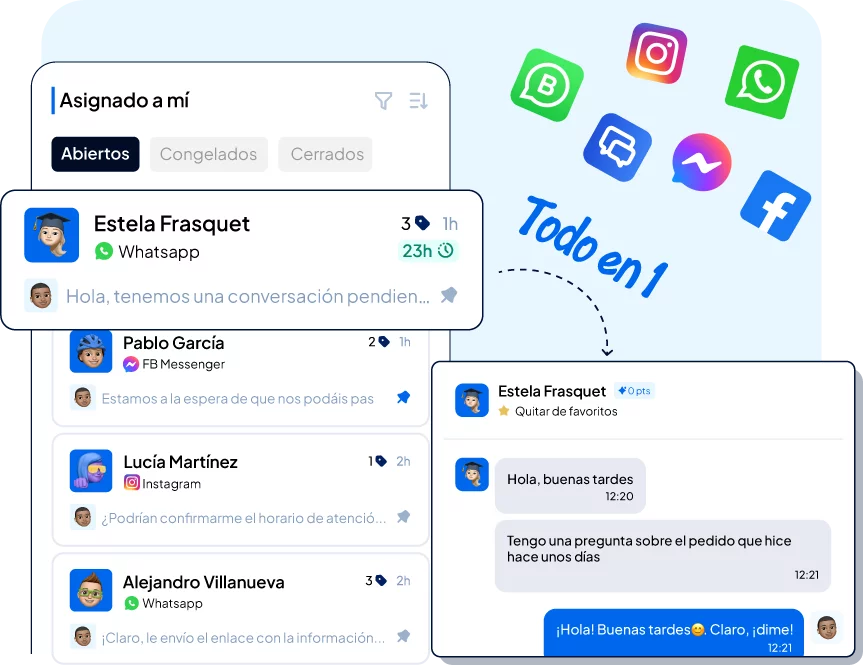
Omnichannel tray:
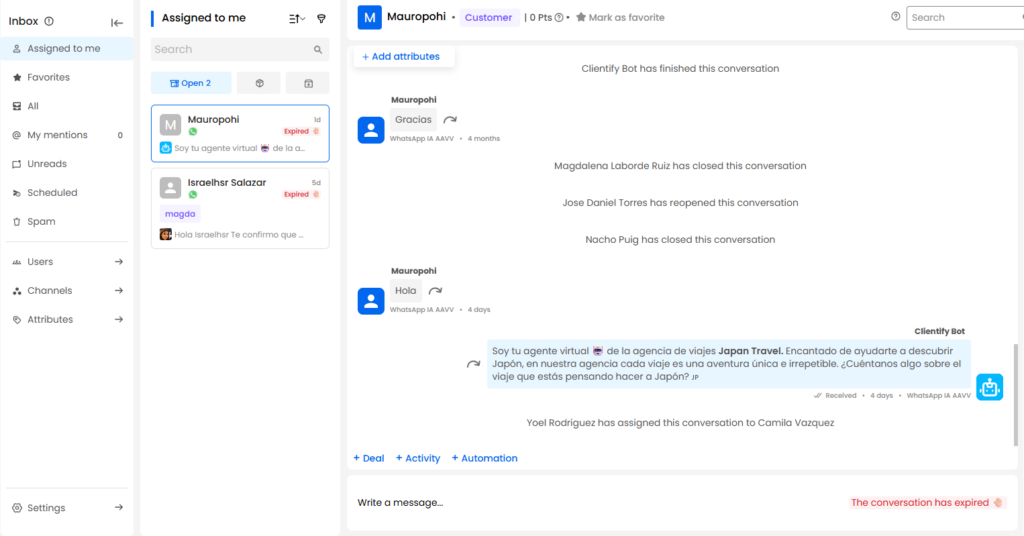
The first thing you need to do is connect all your communication channels to your CRM’s omnichannel inbox. This way, all conversations are centralized in one place, so you don’t have to jump from one app to another.
In addition, Clientify’s Inbox allows you to link AI chatbots to respond after hours, providing accurate answers automatically.
These are key features that make communication and customer follow-up seamless, professional and perfectly traceable.
Automatic customer follow-up flows:
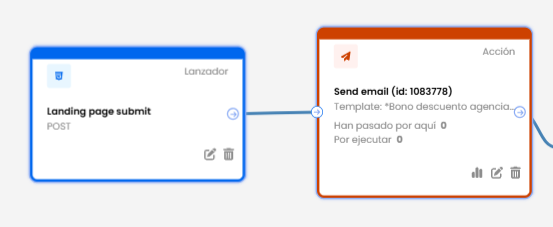
Well, now that you have all your communication channels connected to the CRM, it’s time to define your automatic flows.
- Design a flow so that the system automatically sends a thank you and information email to the lead who has just left you their data.
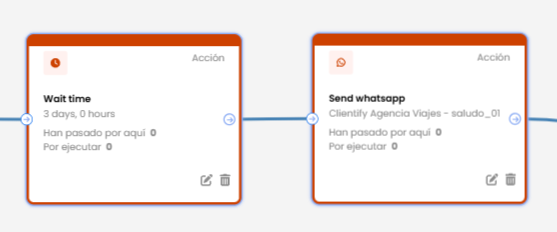
- About 3 days after sending a quote which was not accepted, rejected or paid, have the CRM automatically send a WhatsApp to the contact to see if they have any specific questions they want clarified.
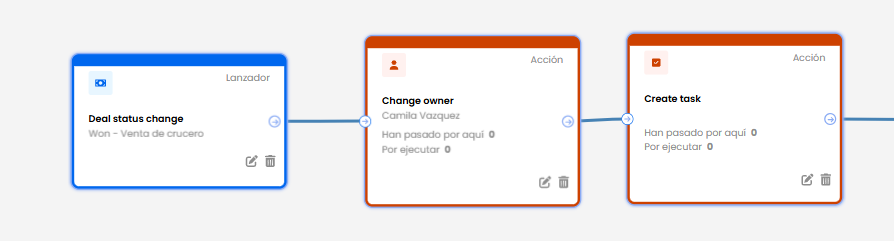
- Defines that once the customer has paid for the service, a task is automatically generated for the administrator to call the customer and confirm all billing data.
The important thing about all these flows is that they not only save time, but they also get all the teams in your company aligned with the business process.
Lead scoring and real-time reporting:
The great thing about a CRM like Clientify is that it allows you to automate lead scoring. Depending on how the contact interacts with your company’s communications, it will automatically add or subtract points, so you know who is closer to buying and can focus your time on these leads.
On the other hand, Clientify offers reports that update your information automatically and in real time. These dashboards show metrics of the opportunities you have active, how many customers you managed to convert, in which stages of follow-up you have the most contacts, etc.
And it is precisely having this data that transforms your monitoring into a growth strategy: what to do, when to do it and who to focus on.
Frequently Asked Questions
1. How often should I follow up with a customer?
It depends on the stage you are in. With a new lead, ideally in the first 24 hours. In negotiation or post-proposal phases, between 3 and 7 days. And once the sale is closed, maintaining monthly or quarterly contact helps to build loyalty.
2. How to follow up without seeming insistent?
The key is to provide value in each message. Instead of asking “Have you seen my proposal?”, send something that helps: a success story, a comparison or a useful idea. This way the customer perceives interest, not pressure.
3. Which channel is most effective for follow-up?
There is no single one. Email is ideal for the formal, WhatsApp for the agile and calls for the decisive. The important thing is to adapt to the channel that the client prefers and maintain consistency in the message, without duplicating contacts.
4. What can I automate within Clientify?
You can automate follow-up emails, task reminders, lead assignments, notifications when a customer opens a message and much more.
Keep in mind that automation does not replace the human relationship, but it helps you to keep it effortlessly active.
5. How do I know if my tracking is working?
Review metrics such as response rate, number of interactions per sale and average time to close.
If your customers respond quickly and opportunities move forward, you’re on the right track. If not, review cadences and channels.
6. What happens if a customer stops responding?
Don’t insist right away. Wait a few days and try a different approach, perhaps a more human message or a different channel. If there is still no response, temporarily archive the contact and reactivate it later with a news or update.
Conclusion
Customer follow-up is much more than a commercial task… it is the ideal strategy to build lasting relationships and generate long-term trust.
Look at the situation your contacts are in and use a CRM like Clientify to define automatic action flows that help you maintain contact at the right time and with the right message. And remember that the key to a good follow-up is not to pressure or sell… but to accompany and connect.
Take advantage of Clientify’s 7-day free trial and start implementing your customer tracking strategy.