
Yes, Hubspot is one of the most popular CRMs on the market…if not the most. But, being such a powerful CRM, it ends up becoming one of the most expensive and complex.
If your company is just growing or you’ve reached the point where you need to fully customize your automations and sales processes, you’ve probably found that Hubspot’ s costs are skyrocketing (and a lot) and that your automations are falling short.
The good thing is that today there are many alternatives to Hubspot: CRMs that are more flexible, adapted to the Spanish-speaking market and that integrate WhatsApp and AI without having to hire separate modules.
So… when should you look for an alternative to Hubspot and how do you know which is the best option for your company? In this post I tell you when to take the plunge, what to consider when choosing a new CRM and what are the 12 best alternatives to Hubspot that can best suit your business.
Subscribe to Clientify’s blog
Do you like marketing, automation or just seeing how other people do things right? Then subscribe.
Every week we send you what we would like to receive: direct and actionable content.
When should you look for alternatives to HubSpot?
The first question you need to ask yourself is why isn’t Hubspot working for my business?
No matter how powerful it is, you need to look for a platform that is more aligned with your growth and market.
Price jumps and limits per plan:
It’s probably happened to you (or you know someone) who started with a free or affordable HubSpot plan, but as they wanted to add features, the prices skyrocketed .
And yes, obviously having a free CRM is always welcome, but those versions have some limits in sending emails, number of templates or number of contacts that sooner or later end up slowing your growth.
Learning curve:
Being such a powerful tool with so many features, its learning curve ends up being quite long. Think that if your SME has a small sales or marketing team, the adaptation to this platform can become interminable; and what ends up happening in most cases is that the platform is not used at all.
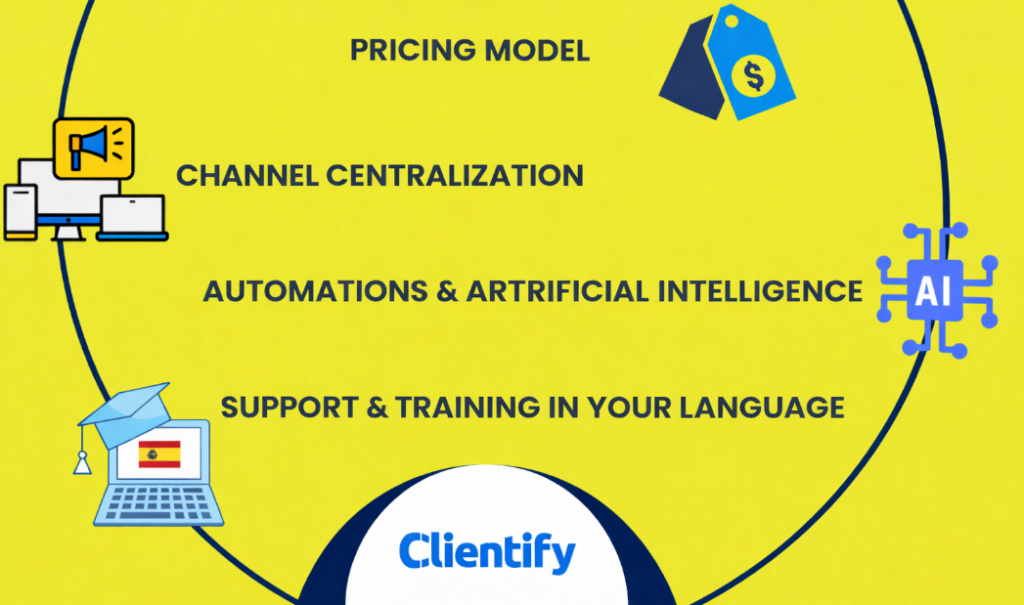
How to choose the right CRM for your company?
Choosing a CRM to work with is one of the most difficult decisions. Think that this tool will be used on a daily basis to connect with your customers, better organize your sales, automate tasks that today take up your time and, above all, grow your business.
Therefore, before choosing the most famous one on the market, make sure that it really suits your company’s needs, size and pace.
Pricing model:
Always check the functionalities you have included in the plan you can pay for. Also check how many contacts you have enabled in this database and if the available users are according to the ones you need to work with this tool.
Ask yourself this question: Would you rather pay more as you grow or maintain a stable cost month after month?
Tip: If your database tends to grow fast, then choose a CRM that doesn’t charge you extra for growth.
Centralization of channels:
The idea of CRM is to centralize all your conversations, sales actions and marketing strategies.
And that means your CRM must be connected to where your customers are: email, WhatsApp, social media, web, online store, phone calls, etc.
Therefore, if you use several channels when recruiting, communicating and selling, look for a CRM that unifies everything in the same contact file… be careful, because by everything I mean everything: the data you entered in the recruitment landing, the email that was sent with information, the call that was missed and the one that was made, the meeting that was held, the proposal that was sent, the purchases made and the abandoned carts that were left…
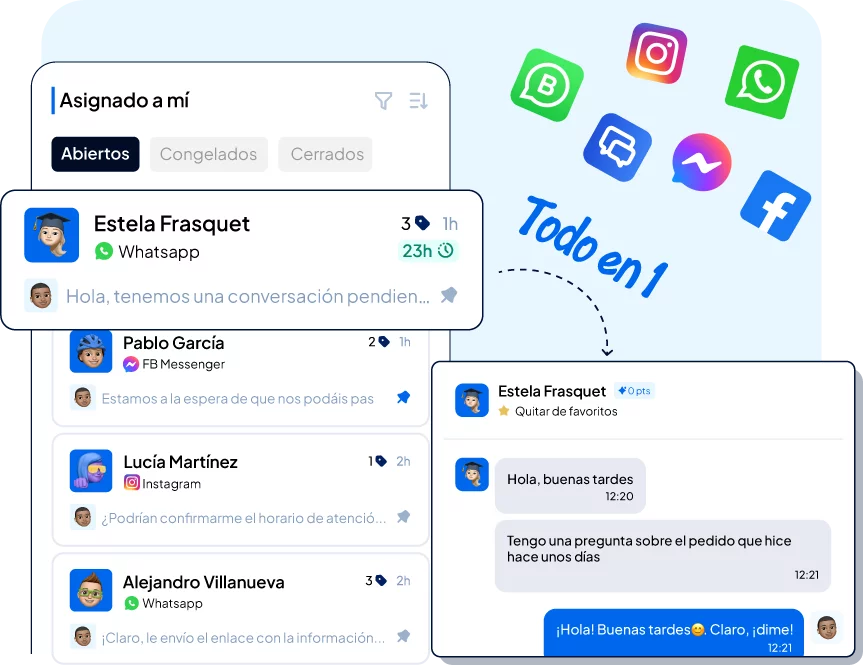
And also, make sure that every message that comes in via email, WhatsApp, RRSS and Live Chat, is reflected not only in the contact’s file, but also in a single inbox so that you can respond, assign and manage all conversations from a single panel .
Automation and Artificial Intelligence:
A good CRM should help you save time on repetitive tasks: sending reminders, classifying leads, generating tasks, triggering automatic messages after an action, etc.
And if it also incorporates Artificial Intelligence, so much the better: an AI capable of creating attractive images and texts, guiding your contacts with assertive answers and searching for key information about your customers and companies.
If all these features help you eliminate the manual and focus on selling, then that CRM is on the right track.
Support and training in your language:
If you are not a developer or a technology expert, then you probably need a platform that will accompany you with videos, templates, webinars, articles and a person to help you in your own language… and even your own time zone.
Therefore, from experience, when making a decision, it is more valuable to have a support team that understands your market, than a platform that is full of features that no one uses.
Top 12 alternatives to HubSpot
Now that you know what your company really needs, it’s time to see what the other alternatives to Hubspot are.
Remember that they are all good tools, but check which one best suits your needs and the way you work.
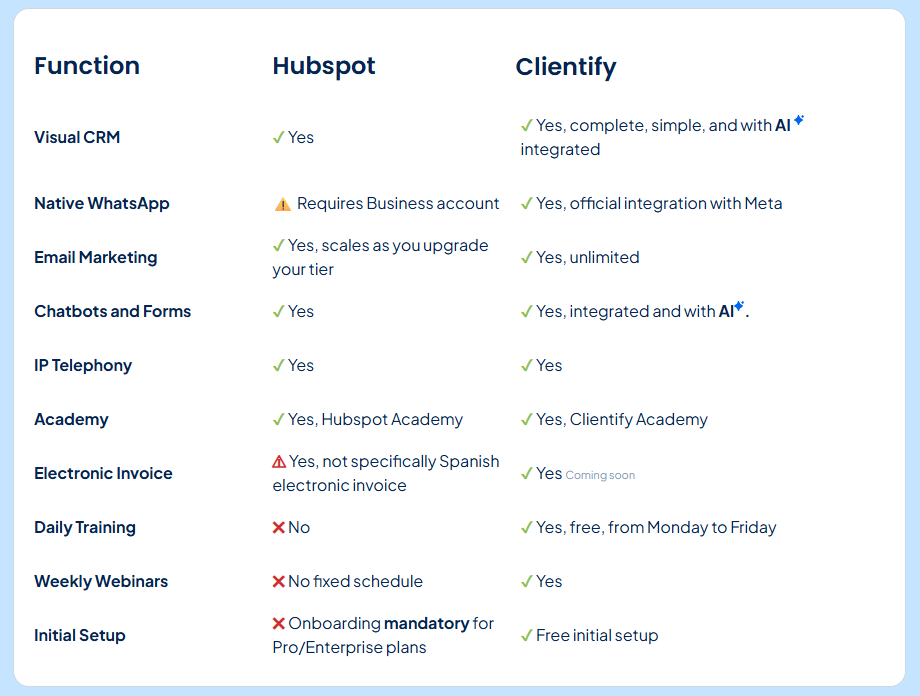
1. Clientify:
Clientify is known as the all-in-one communication, sales and marketing platform with AI.
It is the ideal CRM for when you want to stop jumping between applications and tabs, to have everything in one place.
Think that this tool automatically centralizes all the leads, conversations and behaviors coming from the web, WhatsApp, email, chat, campaigns, ecommerce.
In addition, it has native integrations with META so that WhatsApp, Facebook, Instagram and live chat messages are concentrated in a single Inbox. This way the entire team can see the context of each conversation, respond without losing the thread, reassign chats to the right specialists and make internal comments so that the entire company is aware of each customer’s situation.
On the other hand, Clientify is designed for Spanish-speaking SMEs that want to better connect with their customers, leverage the power of automated marketing and manage their entire sales process from one place with: pre-configured industry templates, lead scoring assignment, automated email and WhatsApp marketing campaigns, reports that update in real time, e-signature, integrated AI, etc.
A key alternative to Hubspot for those companies that sell a lot via WhatsApp and email, but don’t have the time to adopt such a complex CRM or the budget to assume its high costs.
Precisely because Clientify provides you with a large number of automations, integrations and communication, sales and marketing tools without having to make a disproportionate investment.
2. Salesforce:
Salesforce is also one of the most popular CRMs on the market and is designed for companies looking for scalability, customization and total control over their business processes.
Unlike HubSpot, which prioritizes simplicity and the connection between marketing and sales, Salesforce works as an end-to-end platform where you can build a system tailored to your business.
Like Clientify, it does not have a free plan, but its Starter plan includes lead management, opportunities, basic automations, reporting and direct connection to Slack.
Each module can be customized with flows, rules, predictive AI and integrations from its AppExchange, which exceeds 3,000 applications. It is ideal for companies that need to connect multiple teams or manage complex sales on a large scale.
But, being so powerful, it requires a lot of time or technical support to set it up properly.
In summary: if your company already manages advanced processes, large teams and you are looking for a CRM that will grow with you, Salesforce is one of the great alternatives to Hubspot.
3. Zoho CRM:
Like Hubspot, Zoho is also a super complete tool.
But unlike the free plan offered by Hubspot with lots of features, the free version of Zoho has limitations of users and modules.
On the other hand, this CRM allows you to connect campaigns, customer service, billing, support, human resources and much more. In addition, it has Zia as an AI assistant, which helps you predict opportunities, write texts and recommends the best time to contact.
As for the learning curve, HubSpot is easier at the beginning, but gets more complicated at the Pro or Enterprise levels, where automations require more configuration; and Zoho is quite overwhelming at the beginning because of the amount of options, although it is more flexible when it comes to adapting your business flow to this CRM.
4. Pipedrive:
Pipedrive is the ideal CRM if you want to implement a purely commercial platform: it helps you manage funnels without complications, see your opportunities clearly and close more sales without getting lost in configurations.
It has a very intuitive interface: it allows you to drag opportunities, automate follow-ups and have a clear view of the funnel without relying on technicians or consultants. And the great thing about this tool is that you can set it up in just a few hours and get your team up and running.
Unlike HubSpot, which combines marketing, sales and service in one large suite, Pipedrive goes for a focused model, designed to sell more with less complexity.
It offers very useful tools such as Marketplace integrations, AI reporting, automatic reminders, electronic signatures and add-ons for campaigns or project management.
A great alternative to Hubspot as it does not charge per contact, but per user, which makes it clearer and more economical for SMEs and startups that need to control their costs.
5. Monday:
Unlike HubSpot, which groups marketing and sales into separate modules, Monday offers a collaborative and flexible environment where you can design your own pipelines, automate reminders, send emails, manage projects and view the status of your sales in easy-to-understand dashboards.
It is ideal for SMEs or startups looking to start working the same day without technical training.
It has a free plan, and while it doesn’t have great marketing depth, its balance of simplicity, customization and cost makes it a practical alternative to Hubspot for teams that value agility and collaboration over complexity.
6. ActiveCampaign:
ActiveCampaign focuses on making marketing automations by combining email, SMS, WhatsApp and CRM in one tool.
Its great value is in personalization: you can create automatic visual flows based on user behavior and its predictive AI helps you determine the best time to contact or prioritize the most promising leads.
It includes CRM functionality, contact scoring, journey templates and a visual editor that allows you to set up automations without technical knowledge.
An alternative to Hubspot for SMBs that want to automate their sales without relying on a technical team.
Do it all with Clientify: capture, automate and close sales
Centralize all your communication, sales and marketing in one place. Try Clientify free and feel what it’s like to scale your business with AI without relying on experts.
7. Bitrix24:
Unlike HubSpot, which is very focused on marketing, Bitrix24 is another CRM that combines sales, projects, internal communication and customer service in a single platform.
It has a lot of features: you can manage leads, automate funnels, launch campaigns, create web forms , coordinate teams and even build your own website or online store without leaving the platform. In addition, it allows calls, video conferencing and internal chat, reducing the need to use external tools such as Slack, Trello or Zoom.
Like Hubspot, it offers a free plan with unlimited users, and because it has so many possibilities, it has a learning curve that is very overwhelming; with an interface that is not as intuitive as other CRMs.
8. Freshsales (by Freshworks):
Freshsales is Freshworks’ CRM, a platform designed for sales teams that want simplicity, speed and results without spending weeks configuring.
Unlike HubSpot which combines marketing, service and content in different modules, Freshsales focuses exclusively on selling better and faster, with an interface you can master in hours.
It is precisely a tool that is chosen for its balance: easy to use, accessible and with AI features. Its strong point is Freddy AI, an artificial intelligence that helps you prioritize leads, predict closings and generate tasks or automatic follow-ups.
It also includes integrated telephony, mail tracking, visual automations and customizable pipelines that easily adapt to each company’s process.
9. RD Station:
If you operate in Latin America, then RD Station will be very familiar to you.
It combines two main products: RD Station Marketing, to attract and nurture leads, and RD Station CRM, to manage sales and sales funnels.
With this CRM you can easily create automations, landing pages, email marketing campaigns, forms and lead scoring. It has a super clear interface, which is ideal for those who have no technical experience.
In terms of pricing, RD Station offers free plans and quite affordable paid plans.
An alternative to Hubspot idea for the Latin market thanks to its support and training in Spanish and Portuguese.
10. GoHighLevel:
GoHighLevel is a different platform, as it is designed for marketing agencies and consultants .
GoHighLevel offers a comprehensive approach with CRM, automations, sales funnels , email and SMS marketing, WhatsApp, web chat, appointment scheduling, online reputation and even a course or membership builder, managing everything from a single dashboard, without relying on external apps.
On the other hand, it has a SaaS (white label) mode which allows agencies to resell the platform under their own brand.
As for pricing, GoHighLevel does not have a free plan and its base plan is quite a bit higher than other CRMs; but remember that this CRM is ideal for agencies or digital businesses that want independence, total control and the ability to scale without depending on external integrations.
11. Brevo (ex Sendinblue):
If email marketing is the most important thing for your company, then Brevo is a very good option.
In this platform you don’t pay for contacts, but for emails sent, making it a much more economical option than HubSpot.
On the other hand, it offers separate modules for marketing, sales, etc. so that you can hire only what you need.
Its sales CRM is quite simple, but it can be useful for companies that do not want technical complications or high costs.
12. Kommo:
Kommo is a CRM created especially for teams that sell through digital channels such as WhatsApp, Instagram, Facebook or Telegram.
Unlike HubSpot, which focuses on marketing, Kommo focuses on conversational selling, trying to convert messages into real opportunities .
Having a single message tray, it has a very visual and intuitive interface: you can view all conversations, assign them to your team, reply in real time and automate follow-ups with a few clicks.
It has native integrations with WhatsApp Business, Meta and Telegram and the possibility of creating chatbots without code that automatically respond or qualify leads. In addition, it allows you to launch mass messages, schedule automatic flows and measure the performance of each channel.
Being a simpler CRM, it can be implemented quite quickly and is priced (within what it offers) quite affordable.
| CRM | General Description | Key strengths | Learning curve |
| Clientify | All-in-one communication, sales and marketing platform with AI. Centralizes leads, WhatsApp, email, chat, campaigns and ecommerce. | Integrated AI, automations, electronic signature, automatic WhatsApp and email marketing, real-time reporting, native integrations with Meta. | Very low. Adapts quickly and without the need for technical support. |
| Salesforce | Market leading CRM, highly customizable and scalable. | Scalability, customization, advanced AI, +3,000 integrations. | High. Requires support or consultancy to implement it correctly. |
| Zoho CRM | Complete suite that connects marketing, support, billing and HR. Includes Zia AI for forecasting and texting. | Flexibility, customization, predictive AI, variety of modules. | High. Complex at the beginning due to the number of options. |
| Pipedrive | Commercial CRM focused 100% on sales. Visual interface and quick configuration. | Ease of use, simple automations, AI in reports, electronic signature. | Very low. Set up in a few hours and the team can use it immediately. |
| Monday Sales CRM | Visual and collaborative CRM, quick configuration and flexible approach. | Intuitive design, fast customization, integration between sales and projects. | Low. Quick to adopt, but limited in marketing functions. |
| ActiveCampaign | Multichannel sales and marketing automation platform (email, SMS, WhatsApp). | High personalization, predictive AI, visual journeys, powerful automations. | Medium. Time-consuming to set up complex flows. |
| Bitrix24 | CRM that integrates sales, projects, customer service, internal communication and website creation. | Wide range of functions (CRM + project management + communication). | High. Dense platform and not very intuitive interface. |
| Freshsales (Freshworks) | Fast, accessible and AI-powered sales CRM (Freddy AI). | Ease of use, predictive AI, visual automations, integrated telephony. | Low. Simple interface and fast learning. |
| RD Station | Very popular marketing and CRM platform in LATAM, with support in Spanish and Portuguese. | Automations, landing pages, email marketing, lead scoring, simple interface. | Low. Very intuitive and easy to use from day one. |
| GoHighLevel | All-in-one suite for agencies: CRM, funnels, email/SMS, WhatsApp, chat, appointments, reputation and white label. | Comprehensive approach, advanced automation, white label SaaS, total control. | Medium. Large initial curve due to the number of tools. |
| Brevo (ex Sendinblue) | Email marketing tool with CRM and sales modules. | Affordable pricing, pay per email sent, automated campaigns. | Very low. Simple interface and fast configuration. |
| Kommo (ex amoCRM) | Conversational CRM focused on sales via WhatsApp, Instagram, Facebook and Telegram. | Native integrations with WhatsApp and Meta, code-free chatbots, bulk messages and automatic flows. | Low. Quick implementation and minimal learning curve. |
Frequently Asked Questions
1. Which CRM integrates best with WhatsApp?
Today, Clientify and Kommo are the CRMs that offer the most seamless and native integration with WhatsApp Business API.
The difference is in the way of working: Kommo is focused only on chat, while Clientify combines communication, sales and marketing (WhatsApp, campaigns, networks, calls, automations, funnels) within the same CRM, which gives you a complete view of the customer and avoids losing context between conversations.
2. Which alternative is better for small companies or freelancers?
For SMEs and professionals who need something agile, Clientify, Pipedrive and Zoho CRM are three excellent options.
Clientify stands out for being all-in-one (CRM, WhatsApp, email, automation), Zoho for its flexibility and Pipedrive for its business simplicity.
The key is to choose a CRM that you can master without relying on external technicians and that scales with you as you grow.
3. What is the main difference between HubSpot and Clientify?
The big difference is in the approach. HubSpot is a very complete ecosystem but fragmented by modules, where the price grows with your contacts and features.
Clientify, on the other hand, is a unified platform: CRM, marketing, automation, AI and native WhatsApp under one roof, with per-user pricing and support in Spanish.
It is ideal for those looking for speed, control and predictable cost.
How long does it take to implement a CRM like Clientify?
In most cases, you can have Clientify up and running in less than a week.
It includes guided setup, pre-made templates and accompanying articles and videos so you don’t have to start from scratch.
In addition, live sessions and training resources are offered in Spanish. It is one of the fastest CRMs on the market to implement.
Conclusion
If you’re at the point where you don’t want something complex or very expensive, there are simpler, closer and more adapted to the Spanish-speaking market alternatives to Hubspot that can give you the same performance…or even more, without so much friction.
Clientify, for example, is a platform that centralizes communication, WhatsApp, sales, marketing, automation, RRSS, AI, etc., with close support, affordable prices and a fairly quick start-up.