
If today you are only present in networks or by email… then you are falling short.
According to a study Simon Kemp did recently, in 2025, more than 2.7 billion people used WhatsApp every month in the world.
Therefore, WhatsApp marketing is one of the channels that you should not miss. These strategies are one of the most (if not the most) effective when it comes to attracting, activating and building loyalty.
But here the important thing is not to send mass messages just for the sake of it, but to create relevant conversations and send automatic messages that, at the same time, are personalized.
And although it sounds almost impossible, in this guide I will explain how to achieve it.
Subscribe to Clientify’s blog
Do you like marketing, automation or just seeing how other people do things right? Then subscribe.
Every week we send you what we would like to receive: direct and actionable content.
Key ideas of the guide:
- Which messages to send according to the client’s stage
- Why WhatsApp is a key channel to connect with customers
- App vs API: choose the best option for your business
- How to gain trust by complying with the privacy of your contacts
- Real cases that demonstrate the power of WhatsApp marketing
- How Clientify empowers your WhatsApp marketing strategy
What is WhatsApp marketing?
Well… let’s start at the beginning. Basically WhatsApp marketing consists of using WhatsApp as a strategic communication channel, in which you can send from welcome messages, promotions, reminders, to after-sales support and automated campaigns.
The important thing about it is that it is perceived as a more direct and closer channel, achieving an opening rate of 98% compared to 20% for e-mails.
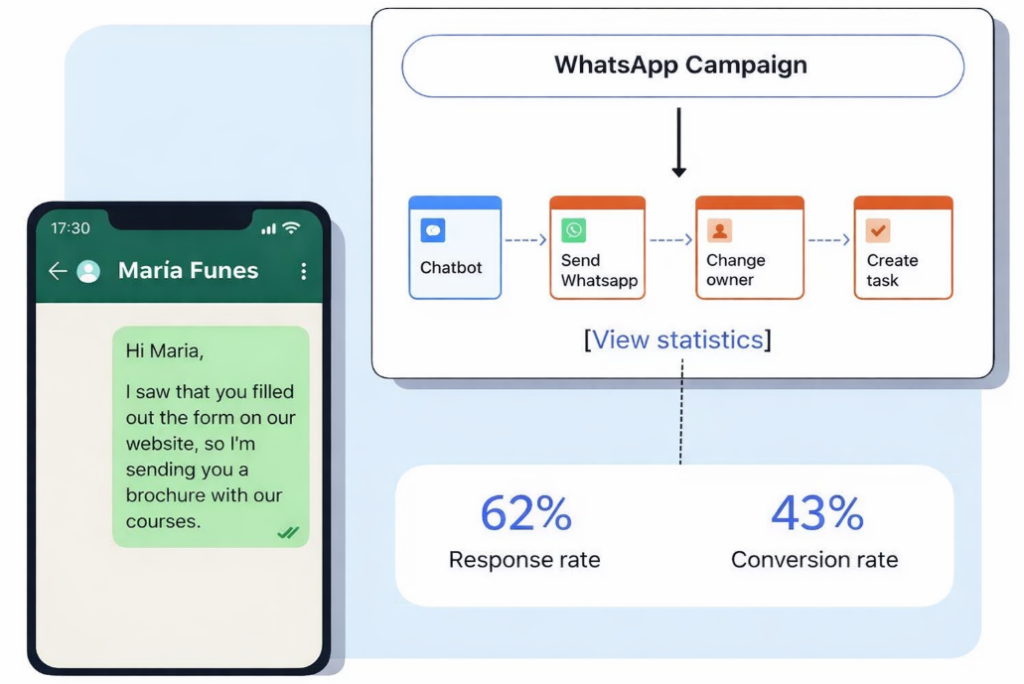
Advantages and disadvantages of the channel:
As with any marketing strategy, this channel also has its advantages and limitations:
The advantages include:
- the immediacy
- personalization with customer data (name, order, date)
- the possibility to automate on a large scale thanks to the API.
- And, as we said before, most people open the WhatsApp app hundreds of times a day, which offers acloser and more direct connection.
Instead, its limitations are that the user ends up blocking your number because of the number of messages you send or because they do not comply with the policies, legality, or consent requested by META.
The power of WhatsApp marketing for your business
I think the figures above make it pretty clear…WhatsApp is not just a messaging application, it is the communication channel with the highest level of attention from users.
And it is the levels of openness and immediate visibility that make WhatsApp marketing the best tool fortransmitting messages that really reach your audience.
In addition, unlike mail that is often opened every two days, WhatsApp messages are responded to instantly, which helps to significantly reduce the sales cycle for companies.
For all these reasons, WhatsApp marketing is no longer an option…and not implementing it in your company will cause you to lose the opportunity to connect in an immediate, direct and personalized way with your customers.
Do you know the legal side of WhatsApp Marketing?
Something very important that you have to keep in mind is that WhatsApp marketing is “regulated”. And what do I mean by this?
Even if you have the phone number of your customers, you need an express authorization to communicate with them. In Europe, the General Data Protection Regulation (GDPR) and the LOPDGDD, in Spain, establish clear requirements on how to obtain, manage and store that consent.
In the case of Latin America, regulations vary from country to country, but they follow the same trend: to protect the user and ensure that he only receives messages if he has actually accepted them.
What is opt-in and how to register it in a CRM?
The opt-in is the permission that a user gives your company to receive your messages and that you can communicate with them through channels such as WhatsApp and mail.
This way, if the person does not accept the consent, your WhatsApp marketing and email marketing communications may end up as spam, or worse, expose you to legal sanctions.
In addition, today there are two types of opt-in: the single opt-in is activated when the user accepts, for example, by checking a box on a form; and the double opt-in has an extra security feature since, in addition to this first confirmation, the user must also confirm his interest through an additional email or message.
The good thing about implementing a CRM for WhatsApp like Clientify is that it allows you to design the recruitment methods such as forms and landings, enable double opt-in, create the data confirmation message and once the consent of the interested party has been granted, manage the communication preferences to design much more effective WhatsApp marketing campaigns.
Meta policies and use of templates
In addition to the consent to be given by the user, as a company, you have to comply with the policies defined by META (the owner of WhatsApp).
Every communication you make proactively through the WhatsApp API, has to be through verified templates. You can design these templates in a CRM like Clientify and wait for META to approve them for use.
The important thing is to use dynamic variables such as customer name, order number or delivery date and not to create messages that promise unrealistic benefits and use aggressive language.
Here is a link to calculate how much Meta will charge you according to the template you send.
WhatsApp Business (app) vs WhatsApp Business API
Now it’s time to design your WhatsApp marketing strategy, but do you already know what type of WhatsApp you are going to use?
Here are the two options that WhatsApp has available:
WhatsApp Business (app):
The WhatsApp Business application is free and is designed especially for small businesses. You can create your company profile with name, address, opening hours and even your product catalog. It also allows you to respond quickly, send predetermined messages and assign labels to organize your contacts.
But this application has some limitations in terms of launching a WhatsApp marketing strategy.
On the one hand, it can only be used on one main device, which means that the rest of the teams or members of your company cannot collaborate; and on the other hand, it does not allow you to automate messages, which makes it much more difficult to manage day-to-day communications.
WhatsApp Business API (Cloud):
In contrast, the WhatsApp Business API is designed for companies looking to professionalize and scale their communication.
Unlike WhatsApp Business that we mentioned before, this is not an application that you download on your mobile, but a platform that integrates with another tool, such as a CRM.
In addition, it has several advantages that are ideal when launching a WhatsApp marketing campaign: you can automate messages by creating flows that are triggered according to user behavior, you can activate a chatbots that attends 24/7, send mass messages using META verified templates, several agents can respond and attend to customers simultaneously and unify all conversations in a single inbox.
What you have to keep in mind is that, to access the API, you must first verify your identity with META and then connect your number to a CRM like Clientify that already has native integration with WhatsApp.
Comparative table: App vs API
To summarize everything we talked about before, I leave you a comparison between the WhatsApp Business app and its API. The important thing is to understand the differences in order to identify which one best fits your WhatsApp marketing strategy:
| Feature | WhatsApp Business (App) | WhatsApp Business API |
| Simultaneous users | 1 main + web | Unlimited |
| Automations | Quick answers | Advanced flows and bots |
| CRM Integration | Limited | Complete |
| Message templates | No | Yes, approved by Meta |
| Scalability | Small businesses | Growing companies |
Prepare your strategy: data, segmentation and CRM
Did you start thinking about your database? If your answer is no, then it’s time to do it.
The success of WhatsApp marketing does not depend on the quantity of contacts you have, but on the quality of that data and your ability to segment it accurately.
Working with unorganized lists or contacts without consent not only reduces the effectiveness of your campaigns, it can also generate legal problems and damage the trust of your customers.
Required fields and labels:
What information do you have about your contacts? The minimum you need to start your WhatsApp marketing strategy is name, phone number, email and proof of consent.
And to differentiate audiences, preferences, interests, etc. you have to add tags. These tags are the ones that will turn your list of names into an intelligent database, capable of segmenting campaigns so that they arrive at the right time, with the right message and to the right person.
Know where your leads come from:
Contacts can come from different channels: forms on your website, ad campaigns, integrations with your e-commerce or even registrations obtained at trade shows and in-person events.
That is why a platform that automatically captures these contacts and automatically registers them in the CRM is so important.
A CRM like Clientify allows you to do all this and more… like measuring acquisition and conversion results and knowing which channel brings you the best quality leads.
Centralize your conversations with an integrated CRM
As we said before, a CRM with a native integration with META, like the one offered by Clientify, allows you to centralize all the information, behaviors, conversations, etc. and make sure your marketing and sales teams are working together.
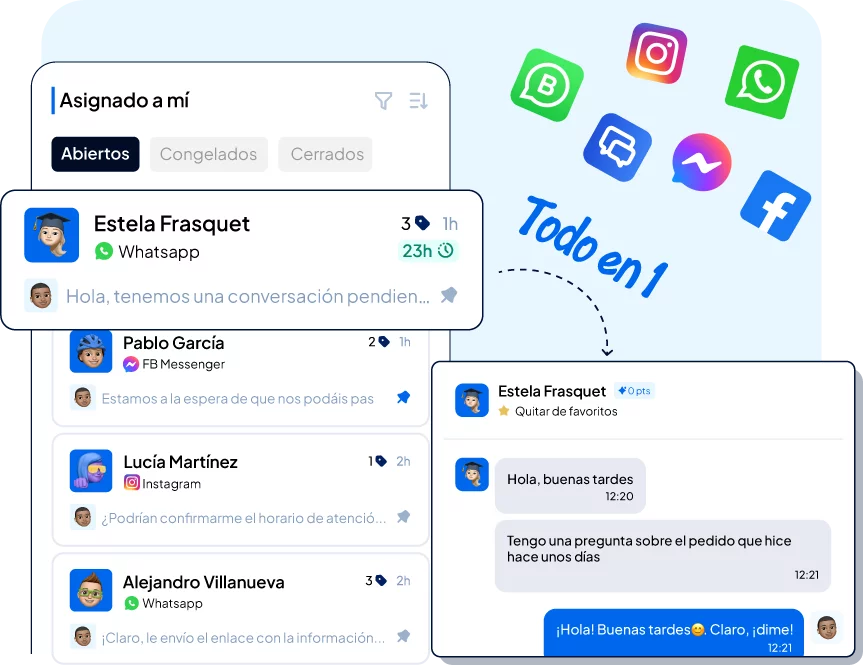
In addition, conversations are recorded in a single inbox called Inbox, so it doesn’t matter if the customer contacted you yesterday via Facebook and today you did it again via WhatsApp: all your communication history is unified in one place .
In this way, you avoid duplicate messages, give continuity to the conversation and maximize the user experience.
WhatsApp strategy and editorial calendar
With everything we’ve been talking about, I’m sure you’ve already realized that you need a plan when designing your WhatsApp marketingstrategy… and an editorial calendar is a key tool that will allow you to plan, maintain consistency in your messages and measure results.
Objectives by funnel stage
Pro tip: Don’t send the same messages to all customers. Think about what stage each one is in before designing each communication:
In the acquisition phase, send welcome messages and provide immediate value, either with free content, exclusive discounts or relevant information for the user.
During activation, your goal is to guide the lead to their first purchase or meaningful interaction, so use clear messaging and direct calls to action.
WhatsApp, in the sales stage, is the ideal channel to transmit urgency with limited promotions, reminders of abandoned carts or notices of last units.
And finally, the loyalty stage seeks to maintain the relationship in the long term. So your WhatsApp marketing strategy has to be focused on publicizing your loyalty programs, getting to know their opinions with satisfaction surveys and sending exclusive content.
Cadence, time windows and pitch
Sending too many messages can be invasive, while doing so sporadically dilutes the connection with the brand, so the key is to find the balance…one or two proactive mailings a week is enough.
Don’t forget, use an approachable, natural tone, adapted to each type of lead; and before launching your WhatsApp campaign, analyze at what times your audience responds best.
Customization and variables
If you send generic messages, then don’t expect much interaction. In WhatsApp marketing, personalization is key.
And the good thing about having your WhatsApp integrated with a CRM like Clientify is that it allows you to use contact data to then, with dynamic variables, personalize each message with the user’s name, interests or interaction history, achieving much closer, more human and effective conversations.
Types of messages and examples
Think about this… not all messages have the same function: some seek to attract and generate trust, others close sales or reactivate leads that seemed lost. The important thing is to design a mix of WhatsApp marketing messages that combine value, opportunity and personalization.
Recruitment and welcome:
Recruitment and welcome messages are the first contact with a new lead. Try to make a good impression, thank them for their interest and offer a useful resource or an initial incentive. A well-designed welcome can make the difference between a user fading away and one who becomes a customer.
“Hi Marta! Thank you for subscribing to our newsletter. Here you will receive exclusive tips and offers designed for you. As a welcome gift, you get a 10% discount on your first purchase, would you like me to activate it now?”
Transactional and customer service:
These messages are those that confirm an action, such as the confirmation of a purchase, a shipment on its way or an appointment scheduled.
“Hello Maria! Your order #4578 has been successfully confirmed. It will be arriving on Thursday the 14th between 10:00 and 14:00. If you need to change the address, please reply to this message by tomorrow.”
Promotions, launches and cross-sell/up-sell:
Use these types of messages to trigger the purchase decision. They can be temporary promotions, notices of new launches or personalized recommendations based on previous purchases. They are ideal for driving quick sales or increasing the average ticket with cross-selling and up-selling strategies.
“Hi Carlos, we know you loved our digital marketing course. This week we are launching the advanced module with an exclusive 20% discount for previous students, do you want to book your place now?”
Abandoned cart reminder:
WhatsApp is the best tool when it comes to recovering abandoned carts. That’s why a short, clear and personalized message can reactivate purchase intent; and they are highly effective because they arrive immediately and to a channel that the customer checks several times a day.
“Hi Laura, we noticed you left some sneakers in your cart – they’re still available! If you complete your purchase today, shipping is free Would you like me to reserve your order for you?”
After-sales, support and NPS:
After-sales messages are ideal for following up, resolving doubts and ensuring that the experience is positive. This is also the place for satisfaction surveys or NPS, which not only allow you to measure the quality of your service, but also convey genuine interest in the customer’s opinion.
“Javier, thank you for your purchase, how was your experience with our service? Answer with a number from 1 to 5, where 5 is excellent. Your feedback helps us to improve and always give you the best.”
The power of templates in your WhatsApp marketing strategy
Do you know how templates work in WhatsApp marketing? Let me explain it to you:
Templates are predefined messages that comply with META policies and are the ones you should use to start a conversation.
The best thing about these is that you can automatically customize them with the data of each contact… as long as you have integrated WhatsApp with your CRM.
And by not having to write all messages manually, yousave time, ensure consistency and increase the effectiveness of your campaigns, whether to capture leads, confirm transactions, sell more or build loyalty among those who already trust your brand.
In addition, just like the messages, there are different types of templates, such as acquisition, activation, transaction, sales and loyalty templates.
Therefore, deciding which one to use and when to use it is the key to your communication strategy.
Automate your messages
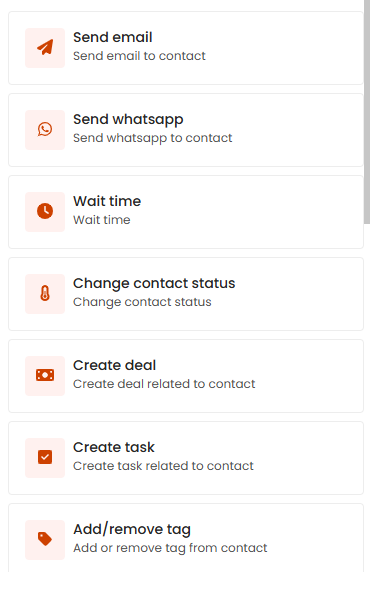
The true potential of WhatsApp marketing appears when you stop sending manual messages and start designing automatic flows.
As with email campaigns, WhatsApp campaigns can also be triggered to be sent in bulk, automatically and to the right people.
In addition, the great thing about automations in WhatsApp is that they not only serve to trigger a conversation, with welcome messages or abandoned carts, but you can also send them according to the behavior that the interested party is having within their decision process.
You know… automating WhatsApp messages allows you to be present at the right time, with the right message and without so much effort. It’s the smartest way to save time, scale your communication and maintain a close and personalized relationship with each customer.
Measure the impact of your campaigns
As in other strategies, in WhatsApp marketing it is also extremely necessary to measure results.
I’ll explain why: it’s the only way to know if your campaigns are generating real impact. So beyond sending messages, you need data that shows you how well the channel is working, how it influences your business and how it integrates with the rest of your strategy.
Channel KPIs: delivery, reading, response, blockages
Start by analyzing these metrics: delivery rate (how many messages actually reach their destination), read rate (level of attention your campaign achieves), response rate (reflects whether the user interacted with the message), block rate (how many of your messages are proving intrusive or irrelevant).
The ideal is to maintain a balance between frequency and value to sustain good channel metrics.
Business KPIs: opportunities, sales, LTV
Be careful, because measuring interaction alone is not enough. You also need to understand how WhatsApp marketing is impacting your business. This is where metrics such as the number of opportunities generated, closed sales and customer lifetime value (LTV) come in.
In this way, these indicators help you connect the effort you make in communication with the real income of your business.
Attribution and reporting:
Attribution is the bridge that connects WhatsApp metrics to the rest of your strategy.
An integrated CRM like Clientify allows you to record which campaign each lead came from , what interactions it has had and how those interactions impact the number of sales.
In addition, reports with channel and business KPIs allow you to detect patterns, replicate what works and correct what does not.
Good practices and mistakes to avoid
You already know that WhatsApp marketing is not about sending messages non-stop, but about doing it with strategy. And although we know that this channel offers very high open rates, a bad use can lead to blockages, unsubscribes and loss of trust in your brand.
To take full advantage of its potential, it is advisable to follow certain practices and, above all, avoid the most common mistakes that tend to ruin campaigns.
Rate and value per message:
One of the mistakes most companies make is sending too many messages in a short period of time. And although we know that WhatsApp is an immediate channel, contacts are not willing to receive notifications constantly.
The ideal is to establish a cadence of one or two proactive messages per week, always respecting the moments of greater receptivity of your audience.
In addition, each message should provide something useful: information, relevant reminders, personalized promotions or content that helps the customer. When a user perceives that each notification has a benefit, they are much more willing to continue interacting in the long term.
Quality of templates:
Here’s a tip: pay close attention to the templates. Not only because META requires them to be clear, transparent and without misleading language, but also because they are the basis for your messages to be effective and well received.
A well-designed template allows you to personalize each communication, maintain brand consistency and increase the likelihood that the contact will respond or take the action you are seeking.
WhatsApp Marketing Cases
Case Study: Elite Plastic Surgery (Health Services)
Elite Plastic Surgery is a company that transformed its recruitment by integrating Clientify with WhatsApp. With the Inbox, they centralized conversations, assigned each chat to the person in charge and activated follow-up automations without overlapping, which allowed them to scale their business. .
The team went from attracting 100 leads to 400-500 thanks to a faster and measurable WhatsApp marketing flow, with a focus on immediate response and funnel continuity.
In addition, they work personalized WhatsApp campaigns from Clientify and measure everything in the CRM (delivery, reading, responses, opportunities and sales), closing the full attribution cycle.
Success story: Atenea (makeup sales)
Atenea worked with a single WhatsApp line and a single consultant, but growth stalled: response times were irregular and there was no visibility into the sales funnel.
With Clientify, they implemented the multi-user WhatsApp, standardized processes and automations, and integrated Instagram into the CRM Inbox.
Today they manage the same line with more than 50 coordinated people, each contact has its own history and assignment, and no one steps on each other’s toes in conversations.
And they got the result they were looking for: five times more sales via WhatsApp and a complete follow-up, with clear metrics of delivery, reading, response and conversions.
Do it all with Clientify: capture, automate and close sales
Centralize all your communication, sales and marketing in one place. Try Clientify free and feel what it’s like to scale your business with AI without relying on experts.
Boost your WhatsApp marketing strategy with Clientify
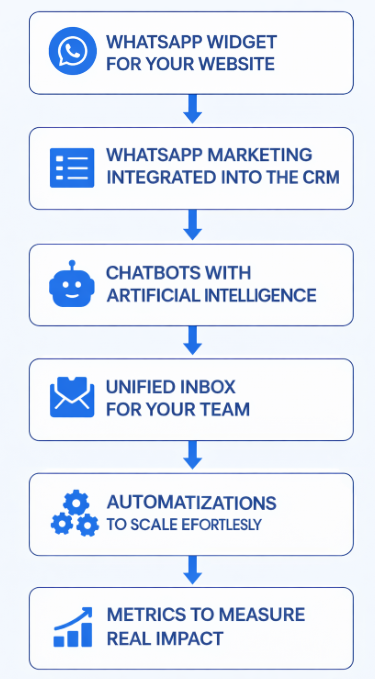
In an all-in-one platform like Clientify, WhatsApp marketing is one of the many tools that accompanies your customers throughout their purchase journey: from the first click on your website to customer loyalty.
Each module is designed to work together, ensuring that you don’t miss opportunities and that your team can scale effortlessly.
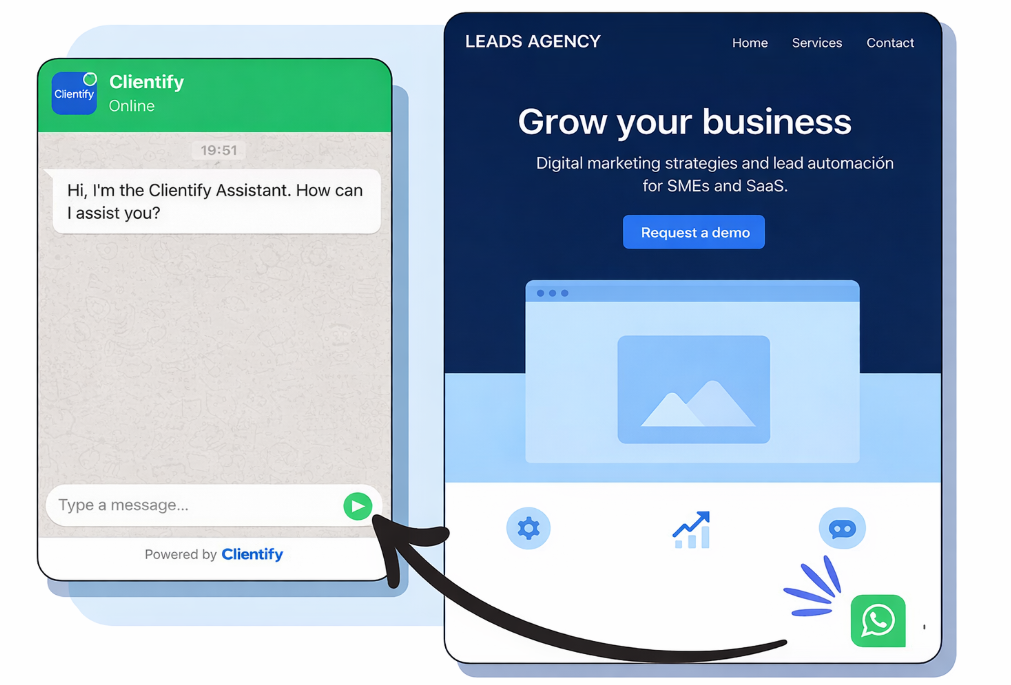
WhatsApp widget for your web:
Let’s start where your customer journey begins: Clientify allows you to design and link to your website a WhatsApp widget, so that any visitor can start a conversation.
This direct access eliminates friction and converts the curious into leads immediately, just when they are most interested.
WhatsApp marketing campaigns integrated into your CRM:
Once the contact data is automatically transferred to Clientify, you can use this CRM to segment, design personalized messages and keep a complete record of each customer’s history.
In this way, your WhatsApp marketing campaigns stop being isolated messages and become strategic, targeted and measurable actions that really generate results for your business.
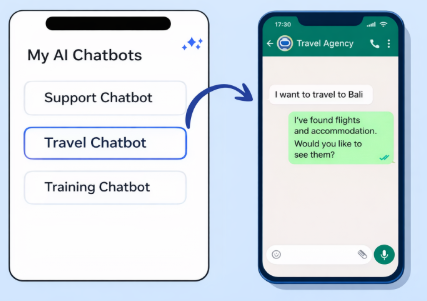
Chatbots with artificial intelligence:
This is where one of Clientify’s many automations comes into play. Clientify’s AI-powered chatbots respond instantly, resolve frequently asked questions, capture key data and, if needed, escalate the conversation to a human agent. This ensures that no lead goes unattended, even after hours.
Unified inbox for your team:
All conversations are centralized in an inbox called Inbox, where marketing, sales, support, billing, etc. work in a coordinated manner. The good thing is that no matter if a customer wrote via WhatsApp, Facebook or Instagram, their history appears in the same place, avoiding duplications and ensuring a fast service.
Automations for effortless scaling:
As I said before, beyond chatbots, Clientify allows you to create different automatic flows: send an email, send a WhatsApp, assign the contact to a specialist, generate tasks to work teams, refer sales opportunities to another stage of negotiation, among others.
Each action occurs automatically based on the contact’s behavior, freeing your team from repetitive tasks and increasing process consistency.
Metrics to measure real impact:
Clientify offers different reports (automatic or customized) ranging from basic indicators (delivery, reading, response and blocking) to business KPIs such as opportunities generated, sales closed or average response time.
Thanks to this visibility, you can optimize your campaigns and make changes before it is too late.
FAQs about WhatsApp marketing
1. How much does it cost to use WhatsApp Business API?
The cost depends on the country and the type of conversation. Meta charges per 24-hour session initiated, differentiating between utility, authentication, marketing or service conversations. To this is added the fee of your provider (BSP or CRM), which may include costs for integration and support.
What is the difference between an app and an API?
The WhatsApp Business app is free and designed for small businesses that manage few messages from a single device. The API, on the other hand, allows you to integrate WhatsApp into a CRM, use automations, chatbots and manage multiple agents at the same time. It is the professional option for scaling WhatsApp marketing campaigns.
How long does META take to approve a whatsapp template?
META usually takes between a few hours and 1-2 days to approve a template, depending on the content. Clear, useful messages without aggressive promotional language are usually approved faster. If a template is rejected, you can correct it and resubmit it.
4. What do I do if the blockages or opt-outs increase?
An increase in blockages is a sign that you are saturating or sending irrelevant messages. The solution is to review the cadence, better personalize mailings and always give a clear unsubscribe option. An integrated CRM will help you manage these preferences automatically.
5. What are the best times to ship?
The best time slots are usually mid-morning (10-12 h) and early afternoon (16-18 h), when users are most active. However, the ideal is to analyze your own metrics to detect the times with the highest response rate in your specific audience.
6. Can I send promotions?
Yes, as long as you have the user’s consent and use META-approved templates. Avoid messages that are overly aggressive or of no value to the customer. The key is to offer useful, clear and personalized promotions, not to saturate them with advertising.
7. How do I connect WhatsApp with my CRM?
The connection is made through the WhatsApp Business API and a CRM with native integration, such as Clientify. In this way, each message is recorded in the customer’s file, flows can be automated and the results of the channel can be measured in conjunction with your marketing and sales campaigns.
Notice how important WhatsApp is today, that it is the channel through which companies gain or lose the trust of their customers.
If you use it in an improvised way, you run the risk of saturating and losing opportunities; but with a clear strategy, smart automations and accurate metrics, WhatsApp marketing becomes the best ally to grow your business.
And the great thing about Clientify is that it’s not just a tool that sends messages…it also centralizes all your WhatsApp conversations (and other channels) in the CRM, automates each stage of the funnel and measures the real impact on sales.
Test all these features for 7 days.