
WhatsApp has become the communication channel par excellence.
You know your customers are there and your competitors are there… but what about you? is your SME there too? because if it’s not, then you’re missing out on a lot of opportunities every day.
But be careful, because it’s not just about sending messages or answering queries: it’s about creating a strategy where WhatsApp becomes a real sales and loyalty channel for your business.
And that’s exactly what I’m going to talk about in this post… how to create a WhatsApp strategy for SMBs that will help you attract more customers, increase your sales and strengthen the relationship with those who already trust your brand.
Subscribe to Clientify’s blog
Do you like marketing, automation or just seeing how other people do things right? Then subscribe.
Every week we send you what we would like to receive: direct and actionable content.
What is a WhatsApp strategy and why does your SME need one?
The first thing we have to make clear is that “having a WhatsApp channel implemented in your SME” is not the same as having a marketing strategy on WhatsApp…why?
Because a WhatsApp strategy for SMBs means using the channel with the objective of attracting, converting and building customer loyalty in a planned way; and not to respond to random messages.
When you have a clear strategy, every message counts. You know what to say, who to target and when is the right time to send that message.
Just so you can send appointment reminders, recover quotes that have gone cold or follow up with unresponsive customers, all with the human tone and style that you manage in your company .
But when there is no defined strategy, your business WhatsApp conversations turn into chaos. Many are left unattended, others with duplicate responses and others that are answered so late that you don’t realize that the opportunity was lost long ago.
Therefore, I give you a piece of advice based on my experience: when defining a good WhatsApp strategy, always ask yourself this question:what goal do I want to achieve? And from your answer, start building the flows, automations and messages that will make this channel become really profitable.
Which is the ideal WhatsApp for your strategy?
But wait a second! Because before you set out to define your strategy, make sure you understand what kind of WhatsApp channel you need.
The answer is very clear: if you want to have a WhatsApp strategy for your SMB, you need to use the Cloud API version. I’ll explain why:
The personal app, or even the WhatsApp Business version, are designed to manage messages manually.
And yes… they are fine when you receive few chats or when you deal with everything yourself, but as soon as you start receiving more messages or when you need more than one person to respond, then they are applications that fall extremely short.
With Cloud API, on the other hand, WhatsApp becomes a professional tool. Mainly because you can connect it to a CRM with WhatsApp, and then start automating responses, assigning conversations to different agents, measuring response times, segmenting contacts and launching campaigns with clear objectives.
Think of it this way, every message that comes in is automatically assigned to the right specialist, your salespeople know exactly who to follow up with, and contacts receive automatic messages based on their interests and needs.
And that’s why only Cloud API can turn WhatsApp into a strategic channel for sales, customer service and loyalty:
First steps to implement WhatsApp in your SME
Well, let’s start at the beginning.
You already have your WhatsApp Cloud API channel active and ready to connect it to your CRM. But first you need to apply these first strategies that are essential for your company:
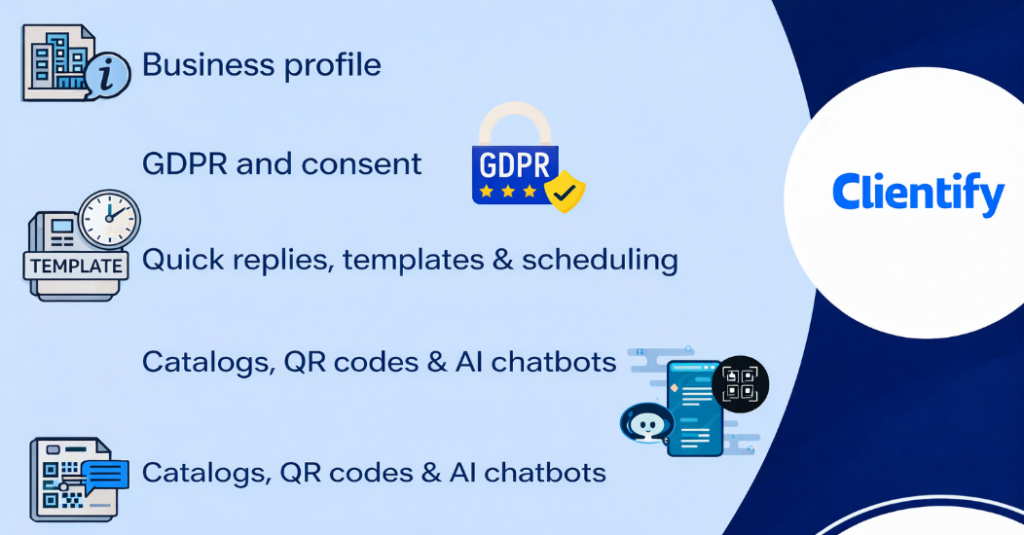
Company profile:
Everything starts with your profile. Think that your profile is your business card and that first impression is very important because it gives confidence and professionalizes your conversations.
So be sure to include your logo, a clear description of what you do and, if you can, a direct link to your website or catalog.
GDPR and consent:
The other key point is consent. Before you write to your contacts, you need to have their permission.
First, because it is required by the RGPD in Europe and other regulations in LATAM, and second because it improves your results. Think that when a person accepts to receive your messages, it is because their level of interest is much higher, which generates a higher rate of openings, responses and conversions.
And the good thing is that a form on your website, a message on social networks or a QR code in your store are the easiest ways to obtain that consent.
The important thing here is that every contact is clear that he/she is agreeing to communicate with your company via WhatsApp.
Quick answers, templates and schedules:
Speed is key. You know that customers expect you to serve them instantly because if you don’t, they’ll go to the competition. And even if you personally can’t give this immediate response, WhatsApp API can.
This channel allows you to create templates and then set them up as quick responses; saving time without losing that human touch.
Create “thanks for writing”, “we’ll be right with you” or “these are our hours” messages that are sent automatically when you’re not available. It’s not about sounding robotic, it’s about keeping the conversation alive while your team gets to respond.
Don’t forget to define your schedule and communicate it in your profile or welcome message. This helps manage expectations and demonstrates professionalism.
Find out here how much you will have to pay for your templates before sending them.
Catalogs, QR and AI-enabled chatbots:
The WhatsApp catalog is key. It allows you to show your products or services with photos, prices and descriptions without the customer having to leave the app.
In addition, if you have a physical location, you can create QR codes that lead directly to your WhatsApp chatbot. And the best thing is that nowadays, these chatbots can be created directly from the CRM itself and with the help of AI.
This way, you will be able to capture leads, guide them according to their needs, attend to them and transform each conversation into a sales opportunity; all in a matter of seconds and automatically.
4 WhatsApp strategies for SMEs that generate customers… and sales.
You already know that, nowadays, WhatsApp can become a great sales engine.
Think that when you use it with strategy, you can attract new customers, recover opportunities that seemed lost and have conversations that end in a real conversion.
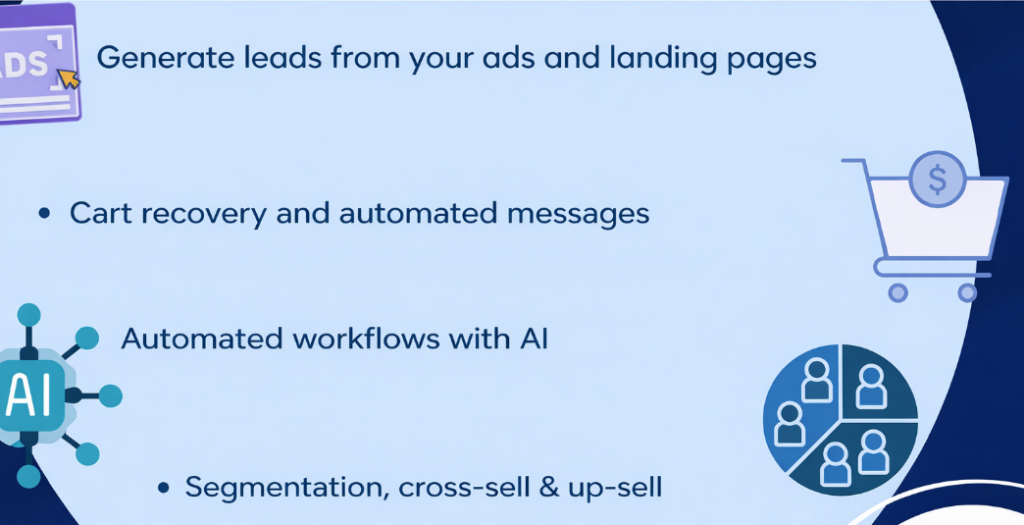
1- Generate leads from your ads and landings:
Imagine someone sees your ad on Instagram or Facebook, is interested in your product and can write you on WhatsApp instantly without having to fill out forms…well, the same goes for landings that include your WhatsApp chatbot .
This shortens the path between interest and conversation, increasing the likelihood of conversion. And keep in mind that people who come through these channels tend to have a higher purchase intent, because they are willing to talk to you right then and there.
The more direct the contact, the closer you are to the sale.
2- Cart recovery and automatic messages:
If you sell online, you know how frustrating it is to see abandoned carts. But with the integration of your WhatsApp API with a CRM, like Clientify you can create automatic messages to be sent when a customer leaves something pending.
Believe me…from experience I tell you: this little push works, and a lot.
But be careful, because this is not only for ecommerce: you can also use it to track budgets, appointment reminders or to know their satisfaction.
The key is to personalize messages and send them at the right time…not too early and not too late.
3- Automatic flows with AI:
Another key WhatsApp strategy for SMBs is sending automated messages with AI .
Artificial intelligence chatbots allow you to answer queries, qualify leads or even close sales after hours without losing the human touch.
For example, when someone asks about your services, the AI can respond immediately, offer options, collect data and pass the conversation to an agent only if there is real interest. This way your team focuses on the hottest contacts and doesn’t waste time on those who are just browsing.
And the good thing is that these flows, when you create them yourself, adapt to the way you sell.
4- Segmentation, cross-sell and up-sell:
Once you already have active customers, WhatsApp also helps you sell more to the same customers.
By having all contacts, customers, purchase history, conversations, etc. centralized in the CRM, you can segment your database and then create personalized messages with complementary products, exclusive promotions or launches, and send them only to those who have already purchased or shown interest.
In this way, WhatsApp becomes a highly profitable channel: not only because it helps you to attract, but also to increase the value of each customer.
WhatsApp strategies in post-sales
I imagine you already know that getting a new customer costs a lot more than keeping an existing one.
And that’s why a well thought out SMB WhatsApp strategy doesn’t end when you close a sale, but continues to build a long-term relationship.
And think that through this channel you can take care, surprise and maintain contact with your customers in a much more human and direct way than by mail or networks.
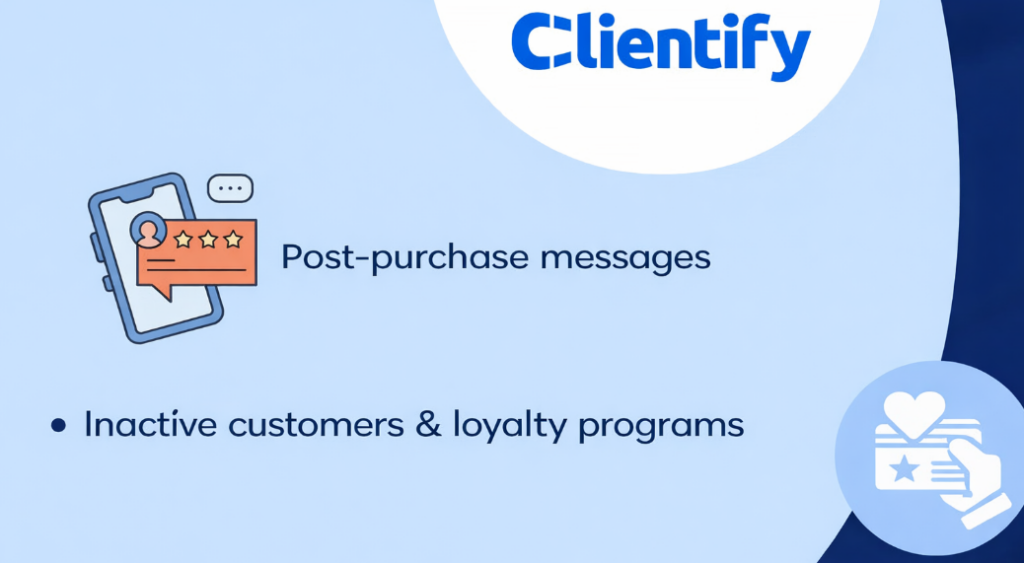
1- After-sales messages:
Once your customer has received the product or used your service, WhatsApp is perfect to ask for feedback quickly and personally.
And the good thing is that it is not necessary to send eternal surveys, the CRM allows you to send a simple message personalized with the name, the product purchased and the date of purchase, in order to obtain valuable information about customer satisfaction, and also to show that your company cares about their opinion.
These post-sales messages have a much higher response rate by WhatsApp than by email, allowing you to react instantly and turn a complaint into a loyalty opportunity.
2- Inactive customers and loyalty programs:
The good thing about having your entire database unified in the CRM is that it allows you to identify which customers have not purchased or interacted with you in a long time.
But the important thing about them is to know that they are not lost, but that they need a well-done reminder that you exist. And with WhatsApp you can re-activate them: send them personalized messages, exclusive promotions or simply ask them if they want to receive your news.
Well-targeted messages are the ones that generate the most positive reactions, since they arrive in a direct and very natural way, without feeling like spam.
Another WhatsApp strategy is to design a loyalty program that sends early offers, discounts or exclusive access.
He believes that the key is to keep the relationship alive, even when the customer is not actively buying. And an SME that maintains continuous conversations via WhatsApp not only sells more, but also becomes a more approachable, remembered and recommended brand.
Key metrics to measure the success of your strategy
Like other strategies, a WhatsApp strategy for SMBs also needs to be analyzed.
And measuring your results on WhatsApp is precisely what allows you to adjust, improve and really understand the impact this channel has on your sales.
These are the most important metrics that you should always keep an eye on:
- Response rate:
Measure how many messages received are responded to by your team. A high rate indicates that your customers are interested and that your attention is fast; a low rate may mean that you are receiving poorly qualified contacts or that they are going unanswered. - First Response Time (FRT) or first response time:
This indicator shows how long it takes you to respond to a customer’s first message. In WhatsApp, every minute counts, and a low FRT can make the difference between closing a sale or losing it.
With an Inbox connected to the CRM you can automate initial responses and intelligently route chats to keep this time under control. - Conversion rate to opportunity or sale:
Not all messages end in a sale, but they should generate opportunities. This KPI tells you what percentage of conversations convert into leads or actual transactions.
The most valuable thing is to cross-reference this metric with your campaigns: this way you can identify which type of message, ad or WhatsApp stream generates the most revenue. - Retention or repurchase rate:
If your customers come back to buy from you after the first conversation, it means your after-sales and loyalty strategy is working.
Measuring retention helps you understand whether you are building relationships or just closing one-off sales. - Satisfaction level (CSAT):
This is about asking the customer, right after a conversation, if he/she was satisfied with the attention received.
You can do this with a simple message such as “Was our service useful to you?” and record the answers in your CRM. This data will allow you to detect areas for improvement and reward the best performing agents. - ROI of WhatsApp campaigns:
ROI is the most comprehensive metric, because it combines your costs with the revenue generated.
Knowing how much you get back for each euro invested in WhatsApp will help you decide whether to scale your campaigns, adjust budgets or modify your segmentation strategy.
How to implement your WhatsApp strategy for SMEs with Clientify?
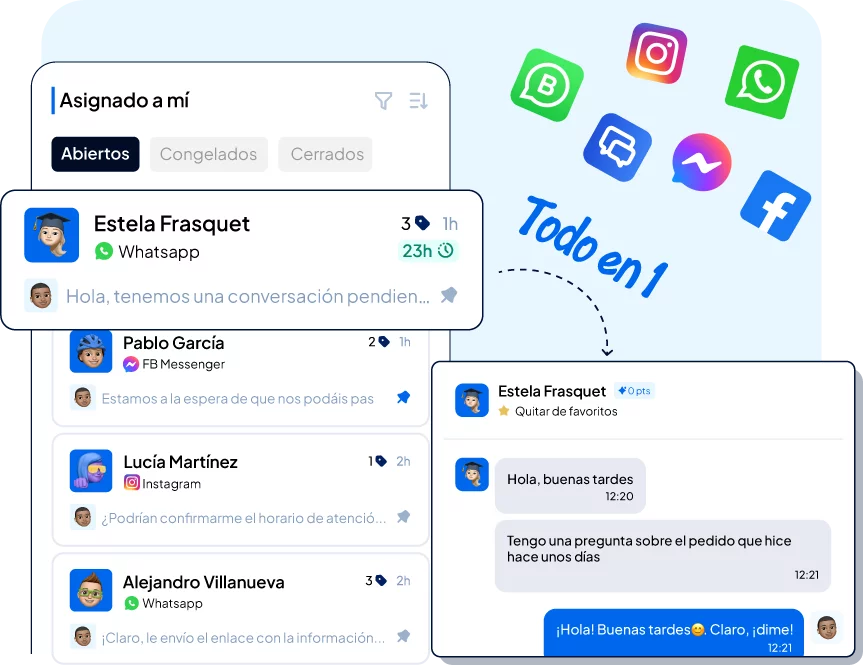
Implementing your WhatsApp strategy in a CRM for SMEs like Clientify is easier than you think. In a few hours you can have your WhatsApp connected via Cloud API, all your conversations centralized in the Inbox (which is also omnichannel) and your contacts organized within the CRM.
With your number connected you can start creating your AI chatbot, assign tags based on customer intent and interest, design message flows and automatic follow-ups, define rules forconversation assignment, etc.
Please note that when creating your WhatsApp templates , you may have to wait a few minutes or hours to use them until META approves them.
Once approved, you can also start designing your automatic campaigns so that, according to the segmentation you have done, highly personalized messages are sent to the right contacts and customers at the right times.
Finally, measure and optimize your results from campaign and conversation reports.
Review metrics such as the number of campaigns sent, the read rate, the evolution of conversations by week, the distribution and assignment to agents, etc.
If something doesn’t work, adjust the flow, change the message or try a new version. So, with a CRM like Clientify that learns and improves every week, your WhatsApp strategy becomes a constant source of solid sales and relationships for your SMB.
Do it all with Clientify: capture, automate and close sales
Centralize all your communication, sales and marketing in one place. Try Clientify free and feel what it’s like to scale your business with AI without relying on experts.
FAQs
1. What do I need to start a WhatsApp strategy in my SME?
All you need is a WhatsApp Cloud API account, a clean contact base and a tool like Clientify to connect everything: automations, CRM and reporting. In a matter of hours you can have it up and running with no technical knowledge.
2. Can I use my current WhatsApp number for the API?
Yes, you can migrate your current number. The only thing that changes is the way you manage your messages: more professional, organized and automated.
3. How many people can answer the same WhatsApp number?
With Clientify’s Cloud API and Inbox, multiple agents can respond from the same number without stepping on each other’s toes. Conversations are automatically assigned according to language, schedule, workload, etc.
4. Can I send mass messages through WhatsApp without being blocked?
Yes, as long as you use META-approved templates and have the consent of your contacts.
WhatsApp penalizes spam, but rewards real and personalized interactions. Segmentation is your best ally to maintain a good reputation.
5. Is it possible to automate responses with artificial intelligence?
Absolutely. You can create an AI-powered chatbot that answers frequently asked questions, collects customer data, and redirects the conversation to a human only when necessary.
In addition, these assistants can learn from the history of interactions, adapt their tone and improve their responses over time. That way you maintain closeness without losing speed or consistency.
6. What happens if I do not comply with the privacy policy?
You could receive penalties or even lose access to your WhatsApp number. Therefore, it is essential to respect the RGPD in Spain and local laws in LATAM, always ask for consent and allow your contacts to easily unsubscribe.
7. What is the biggest mistake SMEs make on WhatsApp?
Use it without strategy. It is not enough to answer quickly: you need clear objectives, well thought-out automations and results tracking. Only in this way WhatsApp becomes a real growth channel.
Conclusion
See…using WhatsApp is no longer enough; what you really need is a well-designed and sustained WhatsApp strategy for SMBs over time.
When you connect your account to a CRM like Clientify, you automate flows, segment contacts and measure results, turning WhatsApp from a simple messaging tool into a great sales, loyalty and customer service channel.
And the best thing is that with this all-in-one platform you don’t need technical knowledge or large investments…with a clear structure, defined objectives and the constancy to measure and improve every week, I assure you that it is enough.
Take advantage of Clientify’s free free trial and start implementing your new strategy.