

WhatsApp or email? That’s the question most companies are asking themselves these days.
And yes, it is really difficult to define whether it is better to write to your contacts and customers by WhatsApp or by email. But the reality is that there is no single answer: both channels play very different roles within a communication strategy.
Therefore, the important thing is not to choose one or the other, but to understand when and how to use each of them to better connect with your customers.
And that’s exactly why I prepared this guide… to help you define the right channel to use depending on the type of message you want to send, the time you want to send it and the relationship you are building with each client.
The importance of using each channel for what it is really for
There is no doubt that both channels work very well…but for different things.
WhatsApp entered the business world to transform the way brands talk to people.
Think… what do your customers expect when they send you a WhatsApp? Immediacy and proximity. And when they send you an email? Clarity and professionalism.
Well, that’s a critical difference…because in an environment where speed matters as much as clarity, deciding which channel to respond, sell or build loyalty through is not always as obvious as it seems.
And that’s where mistakes often start: using WhatsApp for messages that are too long, formal or complex; or trying to sell by mail something that required a more human and direct conversation.
In the end, it’s not just the message that matters, but the context in which you send it and the expectation of the person receiving it.
And that’s the idea…that you understand each channel as a different tool within the same strategy.
Do it all with Clientify: capture, automate and close sales
Centralize all your communication, sales and marketing in one place. Try Clientify free and feel what it’s like to scale your business with AI without relying on experts.
The power of WhatsApp in your communication strategy
As we said before, WhatsApp is no longer just an app for chatting with friends. It entered the professional market a few years ago and since then it has become one of the most powerful channels when it comes to selling, attending and building loyalty.
They have an open rate of close to 90% and most users respond in less than five minutes, making it the perfect channel to start real conversations, resolve doubts in seconds and close opportunities without wasting time.
In addition, with the advance of WhatsApp Business API and its integration with tools such as CRM, you can automate messages, assign conversations to your team or launch segmented campaigns without losing the human touch… ideal for your leads who expect quick, personalized and human responses, regardless of whether they write to you on a Sunday or from the other side of the world.
The important thing is to understand that WhatsApp did not come to replace email, but to complement it, providing speed and proximity in the most emotional part of the customer’s decision process.
Email: the channel that organizes and supports your communication
Be careful! because e-mail is still very present.
It remains the most important communication channel to convey formality, context and follow-up .
Think about what you use your email for: to send proposals? follow-ups? contracts? material with content? Yes… a well-written and personalized email generates trust and transmits seriousness and professionalism.
And that, which has not changed until now, I assure you will not change. In fact, when your customers need to read calmly, review details or make more conscious decisions, email is the ideal space.
Yes… it does not compete with the immediacy of WhatsApp, but it complements it. Think that while one helps you to converse and move forward quickly, the other allows you to document, explain and put everything in writing.
So when you combine both channels with intention, your communications become much more complete: WhatsApp brings you closer, email brings you order. And together they make your sales and loyalty process much more robust.
When to use WhatsApp and when to use email?
You have already seen that both channels serve to communicate with your customers, but the way they do it and the type of relationship they generate are completely different .
And understanding these differences is key to not using WhatsApp when you should be sending an email… or the other way around.
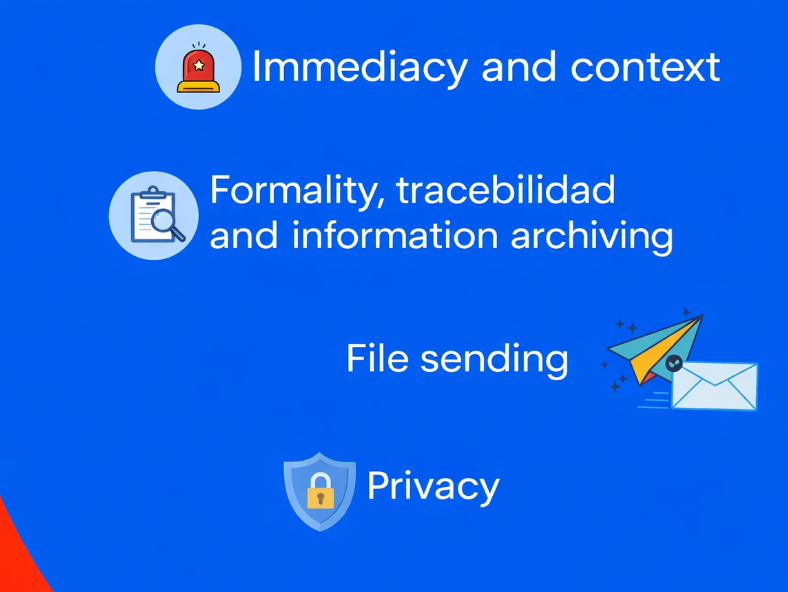
Immediacy and context:
If I tell you immediacy…what do you choose: WhatsApp or email?
As we already said, WhatsApp is the king of immediacy. It is agile , direct and allows you to have a conversation in real time, something that customers value highly when they need a quick response. In addition, the tone is closer, so the barrier between your company and the contact is lowered.
Email, on the other hand, is a more leisurely channel, designed for messages that require context, length, explanation and documentation. Don’t worry… your customers don’t expect an email response in seconds, but they do expect a more structured and complete communication.
Formality, traceability and archiving of information:
What if you need to leave a record of something important: WhatsApp or email?
Let’s see… if today you manage your channels through a CRM, everything will be recorded.
But the reality is that, in these cases, email is still the most reliable medium. Think that in the moments when the client has to make a decision, there are often agreements, budgets and sensitive information.
And although today, having your channels integrated to a CRM allows you to track the delivery, store the conversation and have a record of what was said, when and to whom, ideally at this stage of the buying process everything should be done through an email, which reflects a much more formal tone.
Sending files:
Both channels allow sending files.
But keep in mind that in WhatsApp, the weight limit and file types are more restrictive, so the ideal in this case is to send images, short videos or simple documents.
Therefore, WhatsApp is ideal for the first stages of qualification and moments of loyalty in which the customer has already purchased and needs close follow-up or to resolve doubts quickly.
While mail is perfect for sending proposals, contracts, detailed information or any communication that needs to be reviewed calmly.
Privacy:
You know that personal data has to be treated with great care.
Therefore, when contacting your contacts or customers, either by WhatsApp or email, you must demand their explicit consent.
And that’s why working with a CRM allows you to get that permission through forms, opt-in, and so on.
When to use WhatsApp or email depending on the stage of the funnel?
From experience I tell you…combining both channels is the key to accompany the customer throughout the buying process, but without seeming invasive or missing opportunities.
Each stage of the funnel (TOFU, MOFU and BOFU) has its most natural channel, and understanding it allows you to create a more fluid and human strategy.
Use in TOFU – uptake and first interactions:
In this first phase, you have a very clear objective: to capture attention. Here, email is ideal to massively nurture your new leads: newsletters, downloadable guides or educational content work perfectly to generate interest.
Be careful, because WhatsApp is also very useful at this stage, but when someone has already shown a first interest, for example, by filling out one of your forms. A short, friendly message with a human touch can break the ice and speed up the conversation.
But remember that to send these messages, you must always have the user’s consent.
Use in MOFU – monitoring and conversation:
Well… you are already at the stage where the lead already knows you and the objective here is to maintain the link.
In this case, WhatsApp becomes a great ally to respond quickly, send reminders or resolve doubts that could stop a purchase. It is the channel of proximity and immediacy.
But mail still plays an indispensable role, especially when you want to deliver more in-depth content: comparisons, success stories or personalized value propositions.
Use in BOFU – closing sales, proposals, contracts:
Phew! You are in the final stage, where decisions are made and the sale is almost closed.
So here the balance is fundamental: WhatsApp can help you give that last push, solve a specific doubt or confirm an appointment.
But when it comes to formalizing, email is once again the protagonist, precisely because sending a proposal, a quote or a contract requires a secure and professional environment.
And the great thing about managing both channels from a CRM is that you have the ability to automate these communications without losing control and personalization.
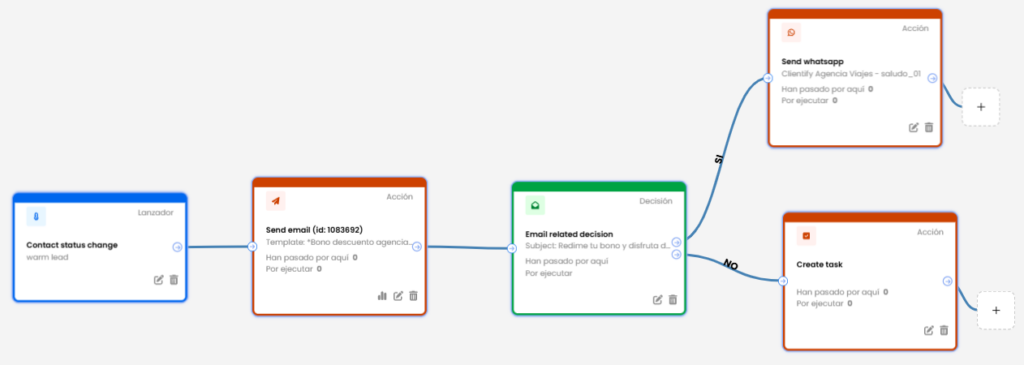
You can send an email with the formal proposal and, at the same time, reinforce by WhatsApp with a short and human message that invites to review it. This small detail speeds up the decision and prevents the client from cooling off.
In the end, BOFU is not only about closing the sale, but also about accompanying the client at the moment when they need the most security and clarity. And when you combine a formal email with a close WhatsApp, you achieve just that: trust, speed and an incredible experience.
| Funnel Stage | Main objective | Role of e-mail | WhatsApp Role |
| TOFU – Recruitment and first interactions | Attracting attention and generating initial interest | Ideal for large-scale nurturing with newsletters, guides, educational content or downloadable content that positions your brand and arouses curiosity. | Useful when the user has already shown interest (e.g. completed a form). A short, friendly message with a human tone can start the conversation and speed up the contact. |
| MOFU – Follow-up and conversation | Maintaining the link and accompanying the decision | Perfect channel to send comparatives, success stories or detailed value propositions, reinforcing trust and professionalism. | It shines in daily interaction: reminders, questions, active follow-up or scheduling meetings, favoring immediacy. |
| BOFU – Closing sales, proposals and contracts | Formalizing agreements and closing opportunities | Protagonist in this stage: proposals, quotations, contracts and any document that requires traceability and reliability. | Ideal to give the last push, resolve final doubts or confirm details. It brings closeness and security in the closing. |
Integrate your WhatsApp or email in a CRM
We have been talking in the whole post about integrating your communication channels to a CRM.
And yes…did you think about what it would be like to have WhatsApp conversations, answer emails, follow up on opportunities and measure results; all from different platforms? Chaos.
The good thing is that when you integrate both channels within a CRM, where every message, email or interaction is centralized, you have everything under control: your team sees the complete history of each customer, you don’t miss opportunities, you automate follow-ups and you make decisions based on real data.
Think that unifying communication on a single platform gives you the possibility of seeing who wrote, through which channel, at what stage of the process and what actions were taken; which means fewer errors, less downtime and a much more fluid service.
In addition, a CRM allows you to measure delivery rates, open rates and know what type of messages generate more conversions.
In the end, integrating WhatsApp or email to a CRM improves the organization, multiplies your ability to offer a consistent experience and enhances the relationship with each of your customers.
Centralize and automate your communications with Clientify
Implementing in your company a CRM like Clientify, which has a native integration with WhatsApp or email, is a step that you have to take.
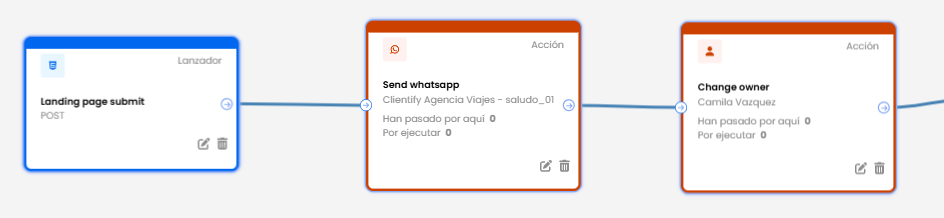
Imagine that a person leaves you his data in one of your landings because he is interested in your service.
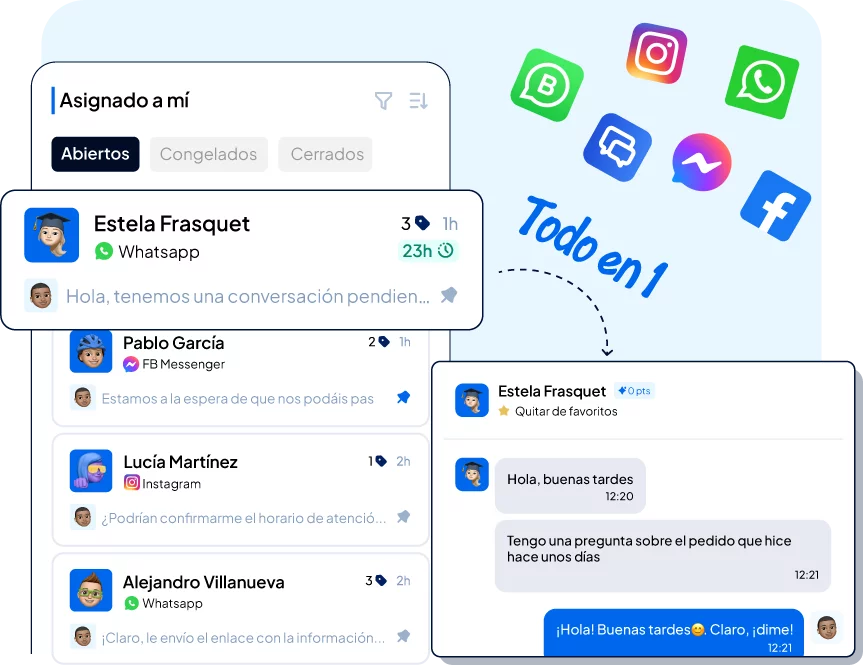
Clientify can automatically send them a personalized WhatsApp with their general information, and if the lead responds to you, that message goes directly to the Inbox where all WhatsApp, email, Live Chat, Instagram and Facebook conversations are centralized.
In this way, the chat is automatically assigned to the correct agent to start answering and negotiating.
And the same goes for email. Imagine you want to send a proposal, a quote or educational material to your leads. Clientify allows you to schedule personalized automated emails for each stage of the process, track who opened them and measure which messages generate the most interaction.
You saw, by integrating WhatsApp or email channels into Clientify CRM, you not only centralize all your communications, but also automate tasks, do effective follow-up and keep your team coordinated.
Design your WhatsApp or email campaigns through Clientify
In addition to individual messages, Clientify also allows you to send WhatsApp messages or mail in bulk.
Think that generating an email marketing campaign with this CRM is one of the least costly strategies for your company, since you don’t have to pay for external tools: with a single platform you can design, send and analyze all your campaigns.
On the other hand, you can segment your audience, personalize messages and measure opens, clicks and interactions to know exactly what content works best.
In the case of WhatsApp marketing, the advantages are just as powerful. As it is an immediate channel and available 24 hours a day, the open rates are much higher than those of email. At Clientify, we have noticed that our own campaigns have an open rate of 67.6% for WhatsApp, compared to 30.2% for email.
With Clientify nothing is lost…everything is registered, centralized and ready for follow-up.
Which channel to choose for your company? Quick decision guide
So, I ask you the same question as at the beginning… WhatsAppor mail?
It depends on what you want to communicate, the type of customer you are going to talk to and where they are in their journey.
This quick guide will help you make smarter decisions by avoiding the most common mistakes when communicating:
WhatsApp or mail?
- If your message requires immediacy, choose WhatsApp: When you need a quick response or to confirm specific details (an appointment, a payment, an address), WhatsApp is the ideal channel. Your idea is always to shorten times and improve the customer experience.
- If you want to leave a record, email is your ally: Messages involving agreements, budgets, policies or legal information should be sent by email. It is the channel that provides traceability and support in case of future revisions.
- Adapt the channel to the level of formality: WhatsApp works best for everyday conversations, reminders or close follow-ups; mail is better when you need to maintain a professional image or send corporate communications.
- Assess the urgency and context of the customer: In B2C markets, where WhatsApp communication is part of everyday life, using it can increase the response rate. On the other hand, in more formal or B2B environments, mail is often the first point of contact.
- WhatsApp as an accelerator of email marketing campaigns: If a contact does not open your emails, a short message via WhatsApp with a friendly reminder or a direct link to the content can increase your interaction rate by up to 40%.
- Define clear automation rules: Not all messages should go out through both channels. Your CRM should help you set triggers: for example, a WhatsApp should be sent only when a lead does not open an email, or when the contact reaches a certain lead scoring score.
- Avoid duplicate communications: The customer should feel consistency, not saturation. Use customized templates and well-defined flows in your CRM to coordinate which channel is used, when and why.
Subscribe to Clientify’s blog
Do you like marketing, automation or just seeing how other people do things right? Then subscribe.
Every week we send you what we would like to receive: direct and actionable content.
FAQs
1. Do I need to have the official WhatsApp API to use it with my CRM?
Yes, if you want to integrate WhatsApp professionally and securely into your CRM. The official API allows you to send automated messages, assign conversations and comply with META policies.
In addition, it avoids blockages or limitations that often occur with unofficial versions.
2. Can I send mass messages via WhatsApp?
It depends on the type of account and the use you make. With the API you can send campaigns to contacts who have given their consent (opt-in). It is not advisable to send mass messages without permission, as you could be blocked by the platform and damage your reputation.
3. Is e-mail still useful for sales?
Absolutely. Email is still the most reliable channel to nurture leads, send proposals and maintain formal communication. Its strength lies in its ability to measure openings, clicks and behavior, which is key for commercial follow-up.
4. How long does it take to configure WhatsApp with the CRM?
If you use an integration like Clientify, the setup is very fast. In a matter of hours you can have your number connected, templates approved and flows active.
The most important thing is to define your messages and automations well before launching.
5. What happens if a customer changes channels in the middle of a conversation?
With an omnichannel CRM like Clientify, you don’t lose track. Both email and WhatsApp messages are recorded in the same contact file, with their complete history.
This way you can continue the conversation from where it left off, without repeating questions or confusing the customer.
6. Is there a limit to the number of messages or contacts in WhatsApp?
Yes, the official API sets limits based on the quality and verification level of your account. As you maintain good practices (response times, low block rate, relevant messages), these limits are automatically extended.
Conclusion
Choosing between WhatsApp or email is a strategy. Each channel has its moment, its tone and its purpose within your communication with customers. WhatsApp brings you closer and accelerates; while email commands and supports you.
Together, they form a perfect communication strategy to attract, convert and retain…but only if you manage them all from one place.
And that place is Clientify: a CRM that connects your email and WhatsApp accounts, centralizes all conversations, automates responses and measures results in real time…and best of all, it allows you to work smarter, but without losing that human touch.
Try it for yourself. Enter our free trial and see how your conversions increase when your communications and teams are in sync.