
Did you know that a CRM completely changes the sales of your ecommerce? Yes… and not only sales. The internal organization and the way you understand your customers also takes a 180-degree turn when you implement a tool like this.
Just think about it: when your online store orders start to grow, the number of query channels multiply and every interaction matters (and a lot), a CRM is no longer a simple database but the operational center of almost all (if not all) of your business.
And that’s exactly why I prepared this guide; to tell you which are the best 7 CRM for ecommerce and what you should take into account when choosing yours .
My idea is to help you see what makes each one different and which one can best accompany you depending on the moment your online store is in.
Subscribe to Clientify’s blog
Do you like marketing, automation or just seeing how other people do things right? Then subscribe.
Every week we send you what we would like to receive: direct and actionable content.
Key ideas:
- Learn what is a CRM for ecommerce
- Learn how to identify the signs that your online store needs a CRM
- Discover the key criteria to choose the CRM that best suits your business
- Meet the 7 best CRMs on the market
Why is a CRM for ecommerce much more than a database?
Let’s start at the beginning.
Many companies still believe that a CRM is simply a place to store personal customer data.
And yes… customer data is stored in this tool. But so much data is stored that it is ideal to help you understand what type of customer is buying from you, and who is interested in your products.
And as we said before, it not only stores data such as name, email and phone number… but also records the interactions that the person has had with your website, campaigns or store, through which channels they contact you, if they have ever purchased , how much money they spend in your store, if they have ever left an abandoned cart, how they interact with your communications, etc.
So, if you feel that you have a lot of data but little clarity, or that you are dealing with WhatsApp, email and networks without a single view, then you are already in need of a CRM for your ecommerce.
A CRM for ecommerce that allows you to unify all that information that today you have scattered, automate follow-ups that you used to do by hand and detect sales opportunities that perhaps you didn’t even know existed; in order to manage your store in a much more orderly, predictable and profitable way.
When does your ecommerce really need a CRM?
That your online store orders are growing every day… it’s a joy. But let’s face it: the more sales, the more chaos. That’s why you need a tool that keeps up with your growth and prevents you from spending more time organizing than selling.
But then when do you really need a CRM for your ecommerce?
- When management consumes you more than sales:
If you find yourself spending more time organizing orders, chats and spreadsheets than serving customers, your current system is no longer up to the volume you handle. You need a tool that gives you time back, not takes it away. - When you need to open multiple tabs to understand a customer:
If you have to check WhatsApp, email, Instagram and your store to know who each person is, you are no longer managing your relationship with your buyers well. That scattering of data ends up slowing down your decisions and complicating any follow-up. - When your team responds without coordination:
If it’s not clear who attended to whom, messages are repeated or queries are lost, it’s not a human problem: it’s a lack of centralization. The right CRM avoids these crossovers and makes everyone work on the same information in real time. - When you keep doing repetitive tasks by hand:
Retrieving carts, sending reminders or keeping track of manual follow-ups can be exhausting. And if your current CRM doesn’t automate these basic tasks, you’re losing efficiency…or worse: money. - When abandoned carts increase and you can’t act in time:
If you don’t have automatic flows that trigger messages when a customer stops, most of those carts are lost forever. You need a tool that responds at the exact moment when the customer is still interested. - When you attend without history or context:
Answering messages without knowing what they bought before, what they consulted or what problems they had forces you to improvise. This affects the quality of service and reduces the likelihood of closing repeat sales or high ticket sales.
4 criteria to choose the best CRM for ecommerce
When choosing a CRM for your online store, the first thing you have to do is to understand which one is best suited to your way of selling and which one will save you the most work.
Therefore, the key is to focus on what really impacts your sales, your processes and your customers’ experience.
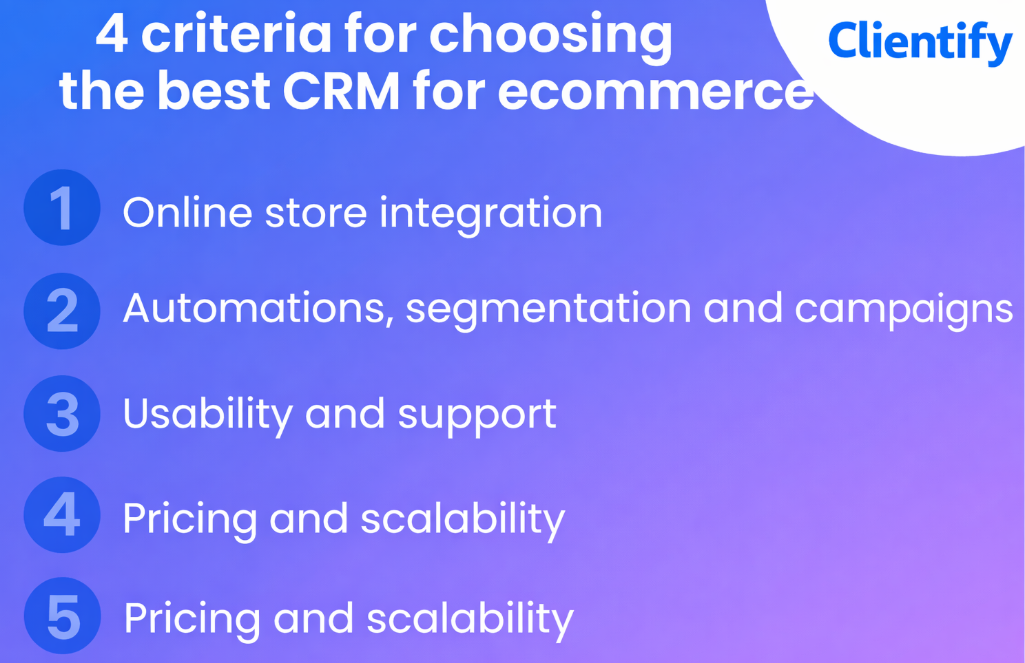
Integration with online stores:
You need a CRM that connects to your online store and synchronizes orders, customer data, abandoned carts and behaviors, without you having to import anything by hand.
In this way, both the personal data and the purchase or abandoned cart data are automatically transferred to the CRM contact file in order to have the entire history unified and then be able to carry out personalized communication and marketing actions.
Automations, segmentation and campaigns:
A good CRM for ecommerce has to have features that help you recover abandoned carts (without you having to send a single message); and the ability to centralize all the information, interests, interactions and communications of your customers and stakeholders to then: segment your shoppers and (almost shoppers) according to what they have seen or bought and design personalized campaigns to be sent at the right time.
Usability and support:
Be careful, because it’s no use having the most complete CRM in the world if no one in your team uses it.
You need a CRM that is easy to understand and adopt…one where your team can jump in, understand it and get to work without having to be an expert.
And keep in mind that the support offered by that platform is also a super important factor. Think that when something goes wrong, you want someone to answer you in your language and without having waited hours for a simple answer.
Price and scalability:
Yes… paying is always the worst part. But keep in mind that the important thing is not only what you pay today, but what this tool will cost you when your company grows.
Many CRMs seem inexpensive at first, but then force you to pay for extra modules, contact limits, paid integrations, or simple features that should be enabled at no extra cost.
The best decision is to choose a CRM that won’t skyrocket when your store sells more and that allows you to scale without having to change tools.
The 7 best CRM for ecommerce
Choosing the right CRM makes a huge difference in how you sell, how you organize and how each customer feels when interacting with your brand. Not all CRMs serve the same purpose and are not the same for every type of online store, so in this list I’ll tell you what makes each one unique and in which cases you should choose it.
Then you can find out which one best fits the way you sell today… and the way you want to sell tomorrow.
1. Clientify:
If your online store sells in Spain or LATAM and you combine web, networks and WhatsApp, then Clientify is the perfect CRM for ecommerce.
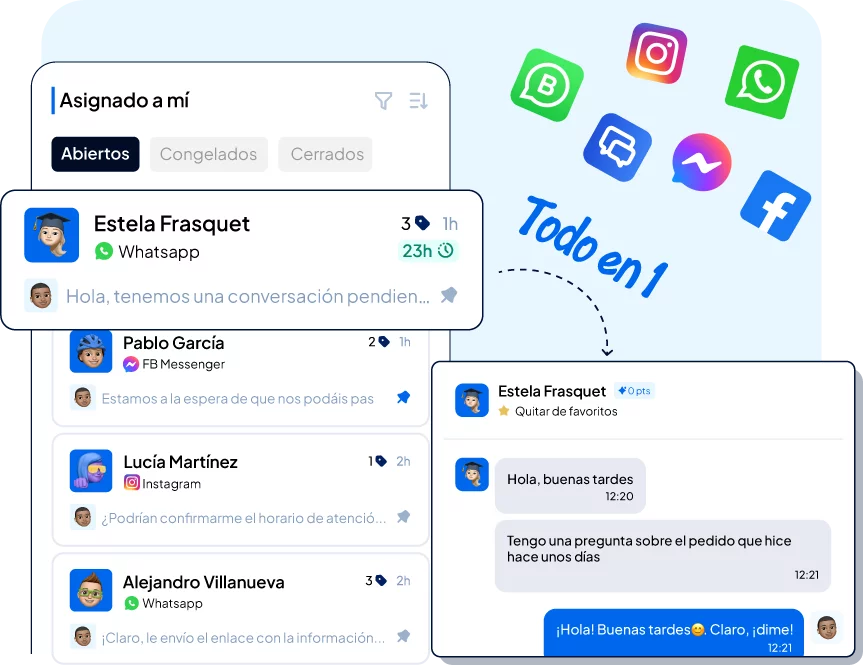
It is an all-in-one platform with integrated AI and WhatsApp, which allows you to have your online store, campaigns, automations, segments, conversations, etc. all unified so you can see who each customer is, what they have done and at what stage of their buying process they are at.
At the ecommerce level, the strong point is how it connects with your store and the rest of your ecosystem. Clientify integrates natively with platforms like WooCommerce, Shopify, PrestaShop or Tiendanube, allowing you to synchronize orders, contacts and behavioral data without losing any key data along the way.
By having all the information centralized in this single tool, Clientify allows you to segment by behavior, interactions, interests, previous purchases, among others, and then launch personalized campaigns and communications: reminders, incentives for cart recovery, recommendations, welcome messages, cross-selling, post-purchase, etc.
Being a company designed for SMEs, Clientify is much more accessible than other large CRMs on the market. You can start with a plan in which you have a large number of CRM, sales, marketing, communications, analytics, AI included, and you can increase the number of users and marketing contacts as your company needs it.
Do it all with Clientify: capture, automate and close sales
Centralize all your communication, sales and marketing in one place. Try Clientify free and feel what it’s like to scale your business with AI without relying on experts.
2. HubSpot:
HubSpot is one of the largest and most important CRMs in the world.
If you have an online store with a large team or if you sell B2B services, this CRM can fit very well because it allows you to have, in one place, the complete funnel: from the first visit to the payment.
This platform connects with stores like Shopify, WooCommerce and uses HubSpot’s automations and email marketing to nurture leads, run campaigns and launches.
In addition, it has a Commerce Hub that allows you to generate quotes, send payment links, manage subscriptions and charge directly from the CRM with its own gateway or via Stripe.
But the important thing to keep in mind is that, although it has a free version, its price increases quite fast as you need more automations, more contacts and more hubs (Marketing, Sales, Service, Commerce, etc).
Zoho:
On the one hand, Zoho connects directly or through connectors with online stores like Shopify and WooCommerce; allowing you to synchronize contacts, orders and products, in order to work the follow-up from the CRM itself; automating basic tasks, better segmenting your customers and having control over the value of each buyer.
But it also has an exclusive platform called Zoho Commerce which gives you the possibility to create your online store and integrate it with the rest of the Zoho ecosystem.
What you should keep in mind is that the more you squeeze Zoho, the higher the learning curve. And be careful, if you don’t have someone who is in charge of configuring it well… it is not an easy tool to implement.
So if you are one of those who enjoy fine-tuning processes and custom fields, it may suit you very well. But if you need something simpler and more oriented to conversational channels like WhatsApp, this CRM may not be the one for you.
4. Holded:
Holded is interesting if, in addition to the CRM for your ecommerce, you want to manage invoicing, accounting and stock management in the same tool.
Note that this tool is an ERP, but it has an integrated CRM module.
In ecommerce, it stands out for its integrations with Shopify, WooCommerce, PrestaShop, Amazon and other platforms. As we said before, the system can generate automatic invoices when an order comes in, update stock and keep your numbers up to date, something key if your sales volume starts to be high and you don’t want to live working on eternal Excel sheets.
It has a CRM that covers basic opportunities, contacts and funnels that do not need very advanced automations.
So, if your top priority is to sort out accounting, taxes and stock, and you need a super basic CRM within the pack; this can be a good tool.
But if your focus is more on marketing, cart automation and omnichannel campaigns, it’s best to look at other options that specialize in that area.
5. Salesforce:
Salesforce, like Hubspot, is in a different league: it is the classic CRM when it comes to large companies, complex operations and projects with many countries, brands or catalogs.
Its combination of Salesforce CRM with Commerce Cloud is designed to create highly personalized shopping experiences, with unified data and a total omnichannel approach, both in retail and pure ecommerce.
Commerce Cloud allows you to manage complex online stores, work with AI for product recommendations, personalize content and connect all this with the rest of the Salesforce ecosystem: Marketing Cloud, Service Cloud, Data Cloud… so you get a 360º view of the customer, from the first click to the post-sale.
But be careful, because all this implies that it is not a light or cheap tool. It requires a serious implementation project and a team that can maintain it.
If you have an SMB with a standard online store, Salesforce will probably be too big for you. But if you run an ecommerce business with many countries involved, high volumes and resources to set up such a robust platform, then this is one of your great candidates.
6. Pipedrive:
Pipedrive is a CRM that is highly appreciated for its simplicity and its visual way of managing the sales pipeline.
At the ecommerce level, it has integrations with platforms like Shopify that allow you to synchronize orders and use purchase data to feed your pipeline.
But be careful, because what you should keep in mind is that Pipedrive is a CRM that is much more focused on sales than on marketing.
So, if you need a simple tool for your sales team not to get lost and if you combine ecommerce with a longer sales process, this platform makes a lot of sense. But if what you are really looking for is something more complete at the marketing level, then I assure you that this CRM falls short.
7. Kommo:
Kommo is a very powerful option if your ecommerce relies heavily on direct conversation with the customer: WhatsApp, Instagram, Facebook, Telegram, etc.
Its main proposal revolves around a unified Inbox, chatbots, templates and automated flows to manage large volumes of chats, but without losing the human touch.
For an online store that sells a lot via WhatsApp or networks, Kommo helps you to centralize messages, create bots that qualify and capture data, and launch mass mailings by controlling the WhatsApp Business API rules.
But if your operation revolves more around the web, carts and native integrations with ecommerce platforms, you will probably have to rely on external connectors and complement with other pieces.
| CRM | What it is and what it offers | For whom it fits best | Key point to consider |
| Clientify | All-in-one platform with CRM, marketing, automations, integrated WhatsApp and AI. Connects natively with Shopify, WooCommerce, PrestaShop and Tiendanube, synchronizing orders, contacts and behavior. Allows segmenting by actual actions and launching personalized communications such as carts, cross-sell and post-purchase. | Ecommerce in Spain and LATAM, digital SMEs and businesses that combine web, networks and WhatsApp. | It is much more affordable than other large CRMs. You can start with a very complete plan and scale users/contacts as your store grows (Here would be the picture and link to the pricing calculator). |
| HubSpot | One of the world’s largest CRMs. It connects Shopify and WooCommerce, allows you to automate emails, nurture leads and launch multichannel campaigns. Its Commerce Hub manages payments, quotes and subscriptions with Stripe or your own gateway. | Ecommerce with large teams or hybrid businesses that mix online and B2B sales. | Although it has a free version, the costs rise quickly as it requires more automations, contacts and additional hubs. |
| Zoho | Complete ecosystem: CRM + email marketing + automations + inventory + invoicing. Integrates with Shopify and WooCommerce. In addition, it has Zoho Commerce, its own platform to create online stores fully connected to the rest of the ecosystem. | Businesses that want to centralize sales, operations and ecommerce in a single family of tools. | The more you use it, the greater the learning curve. You need someone to set it up well; it’s not the simplest or most conversational option. |
| Holded | ERP with integrated CRM. Allows billing, accounting, stock and ecommerce in one place. Connects with Shopify, WooCommerce, PrestaShop and Amazon. It can generate automatic invoices and update inventory with every order. | Ecommerce that prioritizes administrative order, reconciliation, invoices and stock control. | Your CRM is basic. If you’re looking for cart automation, advanced campaigns or omnichannel, it falls short. |
| Salesforce | Enterprise CRM with Commerce Cloud for highly personalized omnichannel experiences. Enable complex stores, AI for recommendations, dynamic content and connection to Marketing Cloud, Service Cloud, Data Cloud and more. | Large ecommerce with many countries, extensive catalogs, large teams and multilevel operation. | It is a robust, costly and time-consuming solution. For SMEs it is usually excessive. |
| Pipedrive | Very visual and simple CRM, 100% sales oriented. Connects with Shopify to take orders and feed the pipeline with purchase data. | Online stores with longer commercial processes or sales teams that need simplicity. | It has very little marketing focus. If you’re looking for automations, campaigns or carts, it’s not enough. |
| Kommo | CRM focused on conversational channels: WhatsApp, Instagram, Facebook, Telegram. It offers unified inbox, chatbots, automations and mass mailings with WhatsApp Business API rules. | Ecommerce that sells a lot through chat and networks, especially with high WhatsApp volume. | If your business relies more on web, cart and native ecommerce integrations, you will need to complement it with external connectors. |
Frequently Asked Questions
1. What is the best CRM for ecommerce if I am starting out?
If you are taking your first steps, the most important thing is that the CRM does not complicate your life. You need something easy to use, that connects well with your store and allows you to automate the basics: abandoned carts, simple segmentation and customer tracking.
In that sense, Clientify is usually a very good option because it already has automations designed for ecommerce, integrated WhatsApp and a much gentler learning curve than other giants in the market.
2. Which CRM for ecommerce is better if I sell a lot through WhatsApp and Instagram?
If your main channel is the WhatsApp conversation, Instagram, Facebook or even web chat, you need a CRM that understands that flow. In that case, the best suited are those with omnichannel inbox, chatbots and conversational automations.
Kommo is very strong on WhatsApp, but if you want something that combines conversation with ecommerce, carts, campaigns and a more complete sales and marketing approach, Clientify is the more balanced option as it doesn’t just stay in the chat; it also connects the entire customer journey, from the first message to the repurchase.
3. Can a CRM help me reduce abandoned carts without having to do everything manually?
Yes, a good CRM for ecommerce automatically detects when someone leaves a cart half full and triggers follow-ups by email, WhatsApp or notifications according to your strategy. This way you recover sales without having to chase each case one by one.
4. Can I use the same CRM for ecommerce in several countries?
Yes, no problem. Almost all current CRMs allow you to manage several countries from a single account. What you have to look for is that the CRM allows you to segment by language, currency, country or channel, and that you can adapt your automations according to the region.
If your ecommerce sells in Spain and LATAM, you are especially interested in the tool having Spanish support, compatible schedules and templates ready for various markets. Clientify, for example, is designed for just that: to operate in Spanish-speaking markets without having to set up parallel structures.
5. Do I need a CRM if I already have Shopify or WooCommerce with marketing plugins?
Yes, because plugins help, but they don’t give you a complete view of the customer, nor do they unify WhatsApp, email, networks and advanced automations. A CRM complements the store and allows you to scale without relying on patches.
Conclusion
In the end, choosing the best CRM for ecommerce is not only about comparing features, but also about understanding which one helps you sell more… but without complicating your life.
You need a tool that connects with your store, that automates what you do today by hand and that gives you a clear view of each customer, from the first click to the repurchase. And above all, a CRM that accompanies your growth without forcing you to overpay or hire other external tools.
Take advantage of the free free trial we have at Clientify and see how your ecommerce conversions improvewith automations, unified WhatsApp management, AI and personalized campaigns.
An ideal tool to convert abandoned carts into sales and customers…into recurring customers.