
Yes, to grow your business you obviously have to sell more. But, be careful because a company does not grow just by attracting and converting.
To really sell, you need to nurture, follow up and, above all, deliver an experience that makes your customers want to come back. And that’s where strategy comes into play.
But not just any strategy. Think about how you manage your customers, where you communicate with them, where you store their information… in a CRM, right?
Well, that’s why it’s not just about installing software, it’s more about designing a CRM strategy that defines how you will engage with your customers at each stage of the buying process.
And that’s what’s important: implementing a CRM strategy that organizes data and also turns every interaction into an opportunity to strengthen the relationship with your customers.
Subscribe to Clientify’s blog
Do you like marketing, automation or just seeing how other people do things right? Then subscribe.
Every week we send you what we would like to receive: direct and actionable content.
Key ideas:
- What is the difference between a CRM and a CRM strategy?
- What steps to take to implement it
- Why CRM is indispensable for your different strategies
- What to pay attention to when optimizing your CRM strategy
What is a CRM strategy?
As we saw in another post, a CRM is a customer management tool that captures, centralizes and automates all types of interaction with the contact.
But a CRM strategy is the plan that is designed to manage the relationship with those customers.
Instead of relying on Excel spreadsheets, emails or even loose notes, with a CRM you centralize all the information and this allows you to work in an orderly and integrated way between the different departments of your company.
The important thing about having a strategy is that you can coordinate campaigns, measure results and make decisions with real information.
And it is this level of organization that generates that customers perceive a closer and more personalized treatment, that your team saves time in manual management and that your company manages to reduce its costs while increasing your income.
Steps to implement a CRM strategy
Designing and implementing a CRM strategy may seem complex at first…but don’t panic.
Break this process down into concrete steps to make it much easier to manage, clearer for your team and effective in achieving your business objectives.
Define your business objectives:
What do you want to achieve with CRM? That’s the first thing you should ask yourself: increase sales? improve loyalty? reduce acquisition costs? With a CRM strategy you translate all these objectives into concrete processes.
Know your ideal customer:
Be careful, because designing a strategy without having your customer defined, does not really make sense… Therefore, it is essential that you configure your buyer persona.
In this case, Clientify allows you to create detailed files in which you define demographic characteristics, professionals, communication channels and even interests. And, since the market changes every so often, you also have the possibility of updating this information based on how each contact is interacting with your campaigns.
Design the customer journey:
Have you already planned the customer journey? When we talk about customer journey, we refer to the journey that a contact makes, through the company, until he/she becomes a customer.
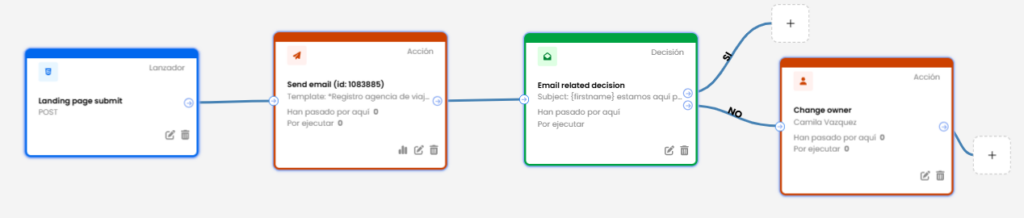
And the good thing about implementing a CRM strategy is that, with this type of platform like Clientify, you have the possibility of designing each step of the process: the interested party registers in the AI landing page you created, an automatic welcome email is sent, Clientify automations assign the lead to a specialist and generate a task for the salesperson to call him/her if the contact does not open the email.
Obviously this path is not finished but the important thing, when planning it, is that you think of each interaction as an opportunity to guide, provide value and bring the contact closer to the purchase decision.
Configure and customize your sales funnels:
You know that every company has different sales processes…and even within your own company they may vary depending on the product, service or market you are targeting.
For example, selling English courses in Europe is not the same as selling in Latin America. And precisely for this reason, your CRM should give you the flexibility to create customized funnels that adapt to each context, so that your team can better manage opportunities and maximize results in each market.
In addition, features like Clientify allow you to transform each stage of the sales process into concrete actions, making your team work in a more organized way and your customers live a more personalized experience.
Form and align your team:
Something important that you should be very clear about, from experience, is that implementing a CRM by itself does not guarantee success. What will really allow you to achieve your goals is the good use you make of it.
That’s why you have to make sure your team understands how it works: how to record interactions, assign leads, understand dashboards without complications, make modifications to campaigns, etc.
And this is where a CRM for SMEs like Clientify makes the difference: we have a knowledge center full of help articles, step-by-stepvideo tutorials that show you how to do everything, guides with examples so your team can learn how to make the most of all the features, personalized meetings with experts to help you implement your strategy, and more.
Establish KPIs and measure results:
What is the point of designing a CRM, communication, sales or marketing strategy if you don’t measure and don’t know what is happening? The important thing to keep in mind is that if you don’t measure, you don’t improve.
Therefore, implementing a CRM strategy involves defining indicators, monitoring results and adjusting actions.
In addition, a CRM like Clientify allows you to get real-time metrics and data, so you can react quickly to opportunities or problems, and make decisions based on accurate and up-to-date information.
Communication, sales and marketing strategies in one single CRM
The good thing about working with a single CRM like Clientify is that it has communication, sales and marketing functionalities , which are key when it comes to capturing leads, following up, negotiating efficiently, converting them into customers and even building customer loyalty over time.
The important thing is that this CRM is not only limited to registering customers, but it is an indispensable leg to coordinate communication, boost sales, and execute marketing actions and campaigns in an integrated way.
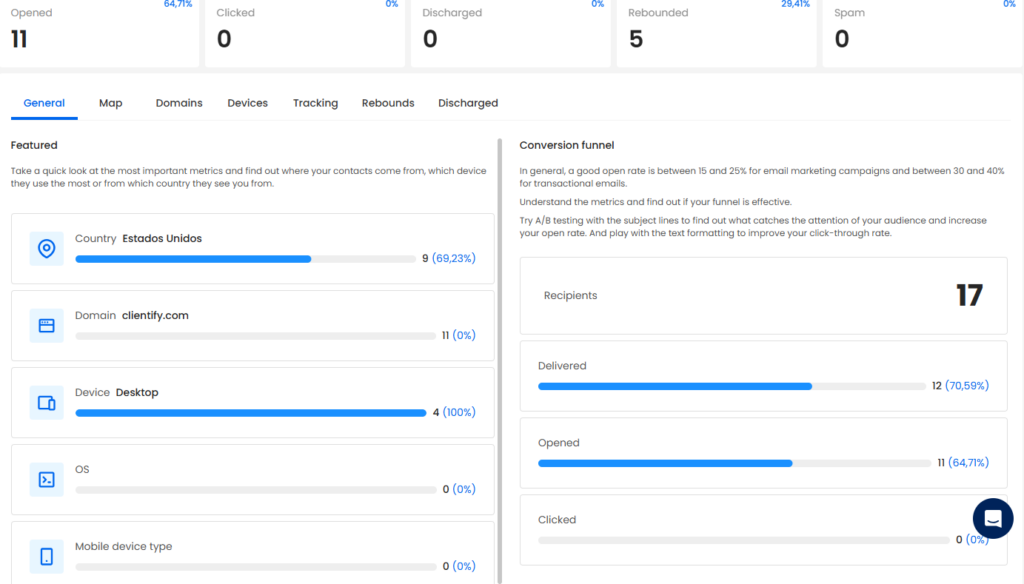
Let me explain why: on the one hand, with Clientify and its AI, your marketing team can design chatbots, landings and forms that capture leads automatically and effectively; and also launch campaigns through channels such as WhatsApp and email, to keep your contacts informed and engaged.
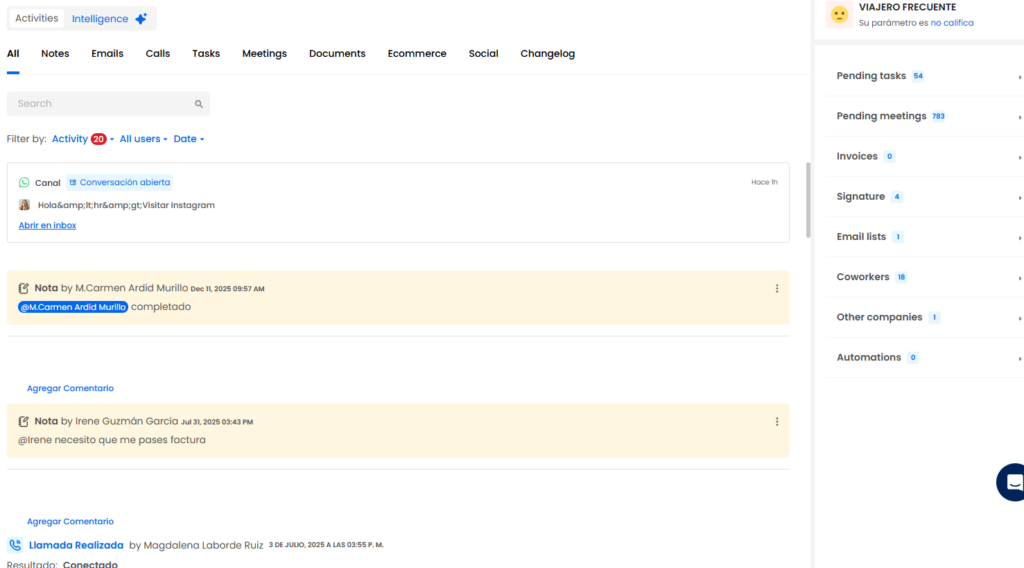
On the other hand, every interaction, information, lead behavior is centralized in the CRM, allowing your sales team to make personalized follow-ups , assign tasks, schedule calls or meetings and negotiate with each lead more efficiently.
At the same time, the communication team also has the possibility to analyze the results of each action, adjust campaigns, segment contacts according to their behavior and generate more relevant content , in order to ensure constant and consistent contact with each customer.
Therefore, as we said before, Clientify is not the typical CRM that only organizes data, but integrates communication, sales and marketing strategies and actions, so that each interaction has an objective, helps convert leads into customers and achieves long-term customer loyalty.
Tips to optimize your CRM strategy
Implementing a CRM strategy is an indispensable step.
Take note of these tips and make sure your team gets the most out of all the CRM features…so that engaging, converting and retaining customers becomes much easier.
Best practices to scale your strategy:
- Update your buyer persona regularly: as we said before, the market and preferences change… they change a lot and very fast. That’s why your CRM has to be able to adapt and reflect this new buyer persona in a clear way so that the rest of the teams understand what type of customer you want to target now.
- Adjust funnels according to real results: it is important that you closely observe how each lead moves through your sales process. If you see that a stage is stagnating or generating lost opportunities, modify the flow to make it more agile.
- Integrate all possible channels: centralizing information from emails, calls, chats, social networks and marketing campaigns avoids duplication and ensures that your team works with complete and updated data.
In this way, every interaction with the customer is recorded, can be analyzed and used to deliver a more personalized experience.
- Train your team continuously: I can guarantee you that a CRM is only effective, depending on how it is used.
So make sure everyone knows how to record interactions, interpret dashboards, modify campaigns and leverage automations.
The better your team manages the tool, the more efficient and profitable your strategy will be .
Do it all with Clientify: capture, automate and close sales
Centralize all your communication, sales and marketing in one place. Try Clientify free and feel what it’s like to scale your business with AI without relying on experts.
4 common mistakes to avoid:
- Use the CRM only as a database: a CRM is much more than a tool to record data…especially a CRM like Clientify. So use it to design and organize processes, automate tasks and make data-driven decisions.
- Not defining clear objectives from the beginning: what is the point of implementing a CRM, and its strategy, if you don’t even know what you want to achieve? That is precisely why it is extremely necessary to define what you want to achieve, so that every action within the CRM has a clear purpose.
- Neglecting training after implementation: The learning curve of a CRM requires constant follow-up. If your team does not receive continuous training, it is likely that they will not take advantage of all the functionalities, decreasing the efficiency and impact of the strategy.
- Leave processes unautomated: Don’t keep performing those manual tasks that CRM can definitely automate.
Thus, you consume time, increase the risk of errors and even delay decision making.
Frequently asked questions about CRM strategy
1. Why do I need a CRM strategy and not just a software?
Software without a strategy is like a car without a steering wheel: it can move, but you don’t know where it’s going. The CRM strategy allows you to define objectives, processes and metrics that will guide your team.
With Clientify, in addition to the tool, you have funnels, dashboards and automations that convert this strategy into concrete actions that boost your sales and build customer loyalty.
2. What differentiates Clientify from other CRMs for implementing a strategy?
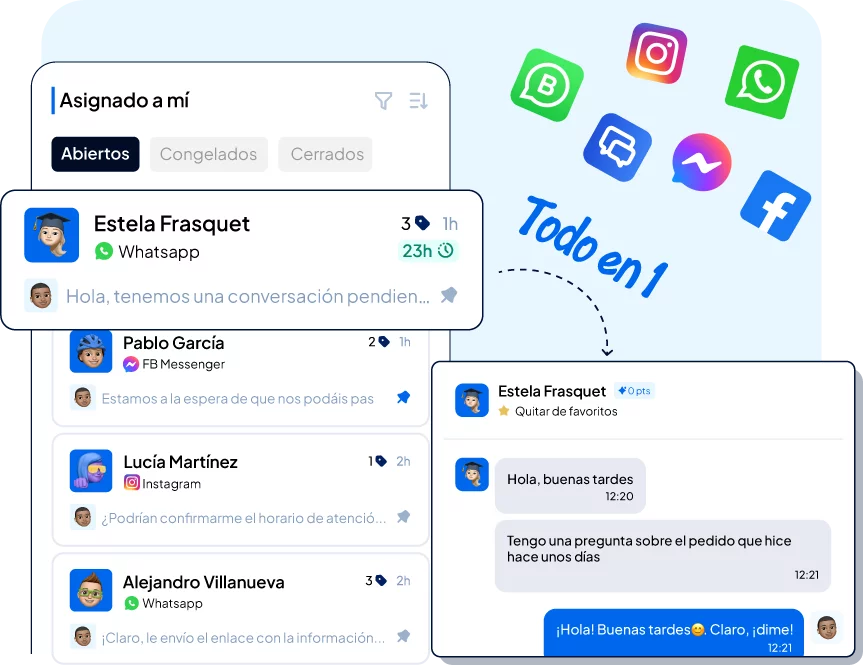
Most CRMs focus on sales. Clientify goes beyond that because it unifies communication, sales and marketing in one place. From the multichannel Inbox, to customizable funnels and AI automations, to performance dashboards, everything is designed so that your CRM strategy is not just theoretical, but is executed on a day-to-day basis in an organized and measurable way.
3. How long does it take to implement a CRM strategy?
It depends on the size of your company and the complexity of your processes. With Clientify, you can have the tool ready in a matter of days, creating funnels, setting up automations and training your team in parallel.
The important thing is to start with clear objectives and scale little by little. In less than a month you can already see changes in the organization of contacts and in the management of opportunities.
4. Which areas of my company benefit most from a CRM strategy?
All of them. Marketing gains in segmentation and reach, sales in follow-up and closing opportunities, and customer service in speed and quality of response. With Clientify, by centralizing communication and having metrics dashboards, each department knows what to do and how it impacts overall results.
A well-designed CRM strategy turns your company into a coordinated whole.
5. How do I know if my CRM strategy is working?
The key is in the KPIs. If you notice improvements in conversion rates, reduced response times, increased customer loyalty or more repeat sales, your strategy is on the right track.
Clientify facilitates this task with customizable reports where you see which campaigns or processes give the best results and which parts need immediate optimization.
6. Can I adapt my CRM strategy to different markets or products?
Yes, one of the advantages of Clientify is customization. You can create different funnels according to the product, service or country in which you operate, configure specific automations and segment contacts by characteristics.
This makes your CRM strategy flexible and adaptable to both B2B sales and more direct-to-consumer businesses.
Conclusion
You saw that there is a big difference between implementing a CRM and implementing a CRM strategy.
With a CRM strategy you have clarity and know exactly how each lead interacts with your company, what actions it takes at each stage and how to guide it until it converts.
And with Clientify CRM, you have the tools you need to turn every interested lead into a loyal customer: a unified tray that centralizes conversations, customizable funnels that organize sales, intelligent automations that save time, and reports and dashboards that show, in real time, whether you are actually meeting your objectives.
Take advantage of the free trial we offer at Clientify for free and implement your CRM strategy with each of our features.