

Many companies use WhatsApp to sell. They try to send hundreds of messages; and respond how and when they can. But have you ever wondered why your sales don’t increase if you are attentive to every message that comes in?
Well, that’s the mistake…answering for the sake of answering. To really sell by WhatsApp you need to be clear about what you want to happen in each conversation.
Think about it for a second. Do your conversations end in a sale, a clear next step or an after we’ll see? Do you know which leads are hot and which have gone cold? Does it all register in the memory of the salesperson who responded that day?
Selling by WhatsApp is not chatting…it is following a process.
And that’s exactly why I prepared this guide; to show you what you need to turn your conversations into real opportunities, what to do in each message and how to stop relying on improvisation to start selling in an orderly, measurable and scalable way.
Manage everything from one place: engage, automate and sell with AI
Forget loose tools, centralize communications, sales and marketing with Clientify.
Activate your free trial and scale without complicating your life.
Why are your sales lost through WhatsApp?
But before we talk about automations or perfect messages, let’s start at the beginning.
Yes, of course. Responding quickly is fine. But responding quickly without context is usually the same as responding poorly. On top of that, imagine that a Xant study showed that up to 50% of leads never receive a response from companies.
Think about this: if every conversation starts from scratch, if you don’t know where the contact is coming from or what he/she has seen before writing to you, you are improvising. And when you improvise, the lead notices it. And there it is. To sell through WhatsApp, your real objective doesn’t have to be to answer.
To sell on WhatsApp you have to understand who is writing to you, why they are writing to you and what your company can do to help them with their problem.
And yes, sometimes it will be a phone call, sometimes a quote, sometimes the scheduling of a meeting. But there always has to be a clear next step, so that the conversation doesn’t just go in circles and end up cooling off.
What is the best tool for selling?
WhatsApp Business or WhatsApp API? That’s the question most companies ask themselves. And the answer is simple: there is no one better than the other. It depends on your volume, your team and how much control you want to have.
Let’s see… no one will deny that WhatsApp Business works very well, but… when everything is simple. One or two people responding, a few conversations a day and a fairly manual follow-up. The problem starts when your business grows (and it doesn’t need to grow a lot).
If you are already at that point where you don’t know who replied and to which lead, if several people reply to the same contact without knowing it, if messages are lost when someone is on vacation, if follow-ups depend only on your memory or if you find yourself every day with unanswered messages, then, from experience I tell you, the WhatsApp app is already hurting you.
And it is at this time that you need order.
Think that, for your company, WhatsApp is no longer a channel for conversation. It is a sales channel.
So: if you want several people to answer the same number, conversations to assign themselves so that no one is left unanswered, automatic welcome or follow-up messages, and you can even see the metrics of how many customers were closed from those who arrived by WhatsApp, then you need a CRM connected to WhatsApp Business.
And be careful, because the API is not only for large companies as many companies think. It is for companies that want to sell via WhatsApp with process, traceability and scalability.
5 key steps to sell by WhatsApp without improvising
Believe it or not, one of the biggest mistakes when selling via WhatsApp is to pretend that each conversation is a unique case.
And of course…being different cases, you have to go out there and improvise. Well…no.
Today, with the help of a CRM like Clientify, you can define a funnel, orderly, simple and human so that eachlead goes through the same stages, without losing context or closeness, so you know exactly what to do at each moment of the conversation.
These are the 5 stages that every WhatsApp sale must have:
Inbound: where leads come from
Be careful, because someone who writes to you from a web form is not the same as someone who comes to you from Instagram or by recommendation.
And therein lies the first mistake companies make: responding to everyone as if they were the same .
Before answering, you need to know where that contact came from and what they were looking for when they decided to write to you. Did they click on a specific ad? Did they see a specific service? Did a client pass on your contact so they could talk to you directly?
The better you understand the inbound context, the easier it will be to connect from the first message. And, believe me, the lead notices…a lot. He feels he’s not starting a generic conversation, but one that makes sense to him.
Qualification: filtering questions
Qualifying is not interrogating, nor setting barriers. It is simply to understand if and when that person can buy.
And the good thing is that this is solved with a few well-thought-out questions: what exactly do you need, when do you need it by, and are you already comparing options?
Think about this: if you don’t qualify, you’ll end up spending time on conversations that go nowhere, while real prospects end up waiting a long time for a response.
Offer: how to send the price without killing the conversation
Everyone is afraid of the price moment.
And the reality is that sending the price should not be the end of the conversation. But then why is it so often? Because it is launched without context, without value and without preparing the ground.
Before talking about price, make sure the other person understands what they are buying and why what you are selling fits them, because price only makes sense when it is linked to the solution to their problem.
In addition, a communication channel such as WhatsApp, is key to accompany the price with a clear invitation to continue talking: a question, a confirmation or the next step.
Closing: summary and next steps
When closing a sale, or communicating the next step, you need to make everything clear. Send a WhatsApp message detailing what has been agreed, what happens now and who does what.
I assure you…we were able to verify that this summary avoids misunderstandings, reinforces commitment and conveys professionalism.
Follow-up: context and timing
Don’t worry…monitoring is not chasing, it is accompanying. But this follow-up only works when the accompaniment is meaningful.
If you know where the conversation left off, when the last message was and what was pending, follow-up is natural.
Also, remember that not all leads are at the same stage: some need a little push and others are not yet ready. And knowing how to distinguish between them is part of the process.
Insisting without criterion burns opportunities; but letting go too soon also. So the important thing here is to detect the context and choose the right timing.
Do it all with Clientify: engage, automate and close sales
Enter for free in the space where Clientify users share tips, help each other and learn how to sell more with AI.
Share your doubts and learn with others who are also growing their business.
Which WhatsApp messages to send at each stage?
Now that you know the different stages of a WhatsApp sale, it is time to define what to say in each one of them.
The important thing here is not to give pretty or robotic answers, but to respond to messages designed to advance the conversation, provide clarity and take the lead to the next step in a natural way.
- First message: this message defines the tone of the whole conversation. It should be close, clear and contextual. Introduce yourself, recognize where the lead is coming from and propose to keep talking. Don’t focus on selling, focus on connecting.
- Quick qualification: send a direct and polite message, but include a thoughtful question. Qualifying doesn’t scare off the prospect; on the contrary, it conveys professionalism and shows that you value their time.
- Sending an offer: this message should combine clarity about what you are offering, value on why it fits and reassurance that others have already trusted you. A brief reference to customers or results helps reduce uncertainty.
- Handling objections: objections are not a rejection, but a doubt. That is why your response must provide security, clarify what is necessary and accompany the decision without pressuring. It is not about convincing, but about helping to decide.
- Follow-up: as we said before, follow-up works only when it is logical. Take back the context, avoid reproaches and propose a concrete next step. If there is no response, make a soft and elegant last call to close the conversation well.
- After-sales and repurchase: be careful, because a sale does not end at the moment of payment. A good after-sales message reinforces the decision and takes care of the relationship, so that over time, this same channel becomes an opportunity for repurchase, recommendation or upselling.
How does Clientify help you sell through WhatsApp?
Scoring, templates, context, tracking, order…seems like a lot to do everything by hand, doesn’t it?
The good news is that today, all this and much more, is done through a single tool. And that tool is called Clientify.
With this CRM you leave behind duplicate conversations and forgotten follow-ups, to have order, visibility and real closeness in every WhatsApp conversation.
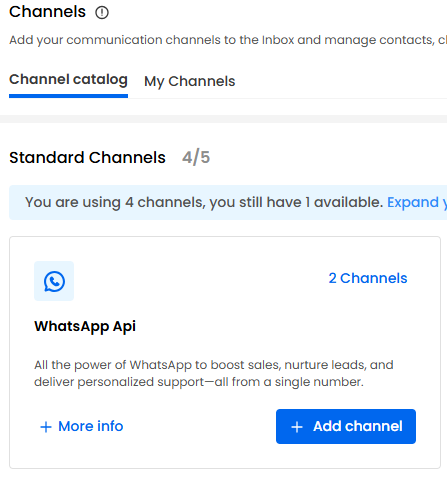
WhatsApp API natively integrated into CRM
Let’s start with the most important thing. WhatsApp is not an external tool or an add-on. It is directly part of the CRM itself.
This means that every message is recorded in the customer’s record and every conversation is linked to a task, automation and sales opportunity.
You stop talking to single numbers and start talking to identified leads; ensuring that each conversation leaves useful information that later translates into better follow-ups and more sales.
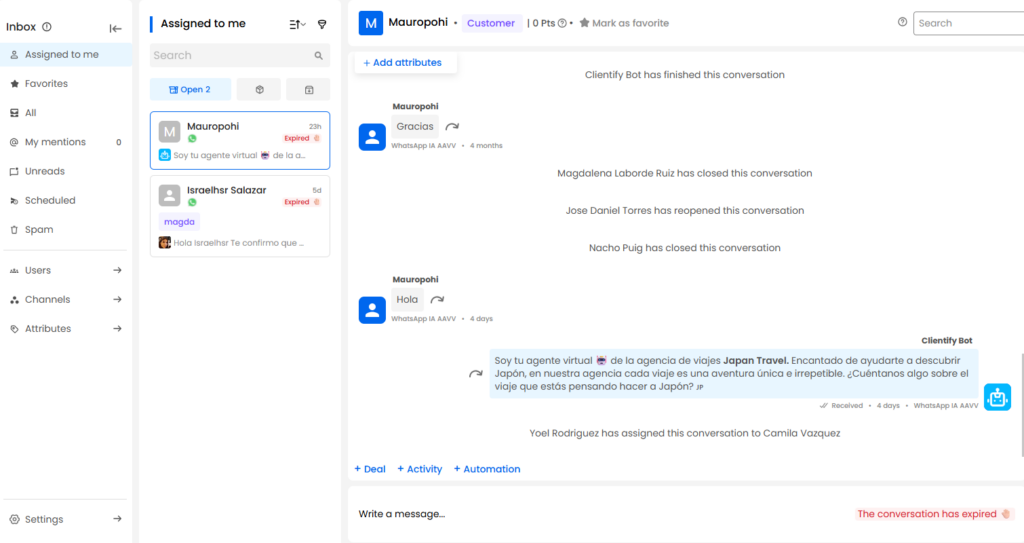
Multi-user Inbox: each conversation has its own owner and context
For your team to sell on WhatsApp, the first thing you need is order.
And as we said above, Clientify centralizes all conversations, in the contact’s file and in an Inbox, where each lead is automatically or manually assigned to the right person.
This avoids duplicate responses, awkward silences and the typical mistake of thinking that another colleague was in charge of the conversation. In this way, each chat has a clear person in charge, a complete history and the necessary context to continue the sale without starting from scratch.
Automated messaging and tracking
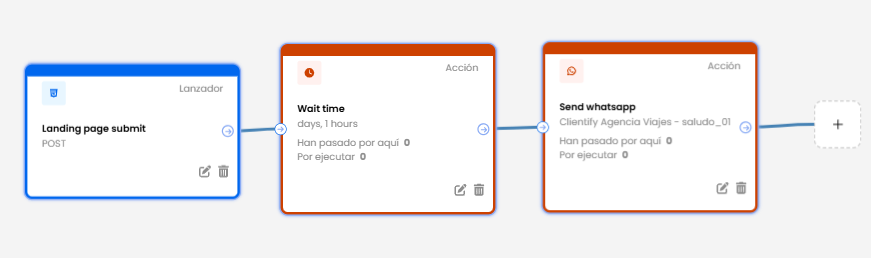
The great thing about working with a CRM like Clientify is that it allows you to automate welcomes, follow-ups, reminders, etc. based on what is actually happening with each opportunity.
For example, you can trigger an automatic message when a lead comes in, create tasks for the salesperson if a quote is rejected or send a follow-up message to resume the conversation at the right time.
All connected to the pipeline, so that the salesperson focuses on closing the sale and not on remembering who to write to, when to write or what was said last time.
Templates, chatbot and reports
Clientify allows you to create and send message templates that maintain a human and consistent tone, design AI chatbots that qualify, answer frequently asked questions, guide the conversation, refer agents, etc. and get reports to measure what’s actually working.
On the other hand, it gives you the ability to see active conversations, created opportunities and closed sales from WhatsApp, allowing you to understand what works, what doesn’t and where to improve.
Implement your WhatsApp in 7 days
Yes, many companies believe that putting this process in place takes a long time.
But…you have no more excuses. With a clear plan, in one week you can go from having impromptu conversations to a system that your team really understands and uses.
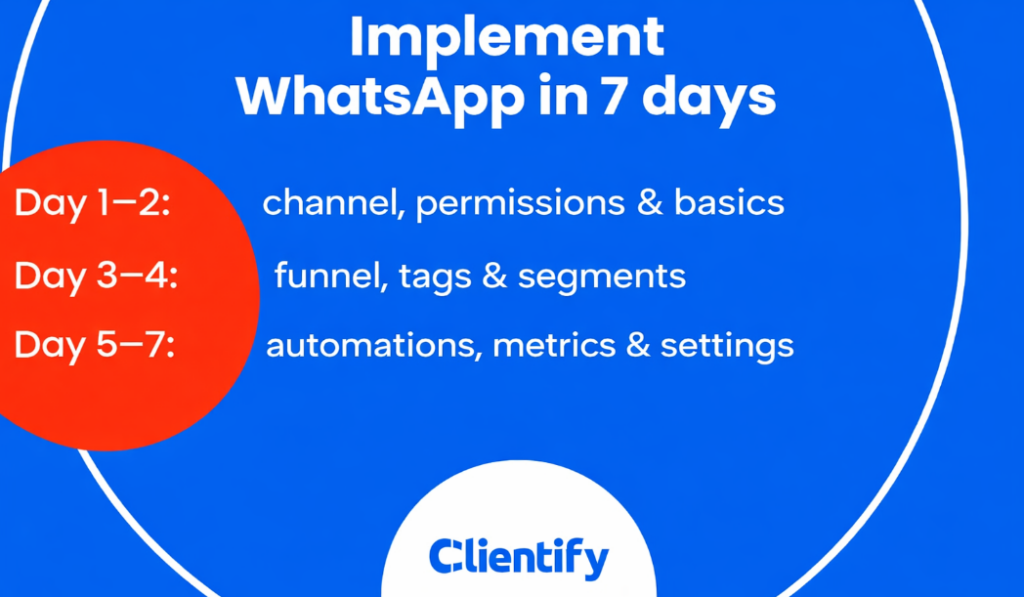
Day 1-2: channel, permits and bases
The first few days are for laying the groundwork. You need to connect your WhatsApp to Clientify, check where people are entering your WhatsApp from, if the consent is well thought out, and what minimum messages you need to get started.
You have to create the templates with your initial greeting, your qualification messages and the right way to present your offer. Remember: nothing fancy, just clear and consistent.
It is also the key moment to define the basics, so that your entire team responds with the same tone and criteria; and so that the customer experience is consistent from the first contact.
Day 3-4: funnel, labels and segments
Now it’s time to give structure to the conversations. In these days you are going to define your sales funnel, deciding the path that the lead will take from the moment it enters your company until it buys or is discarded.
You will create the tags to be assigned (manually or automatically) to the contacts so that you can segment them.
All this will help you not to lose context: new leads, quotes sent, pending response, customers, etc. allowing any member of the team to understand in seconds where each conversation is at and what to do next.
Day 5-7: automations, metrics and adjustments
Turn on simple automations that save time without sounding impersonal, set up reminders so no follow-ups slip through the cracks, and start looking at reports and their basic metrics.
It’s not about analyzing everything, but about answering simple questions: how many contacts reach your WhatsApp, how many conversations are progressing and where they get stuck; so that, with that data, you can adjust messages, times and priorities.
Frequently Asked Questions
1. Is it possible to sell through WhatsApp without WhatsApp API?
Yes, you can. Many companies sell using only WhatsApp Business. The problem is not whether you can, but how far you want to go.
If you have low volume and a small team, it may be enough. But when you need order, real tracking and visibility, the API connected to a CRM stops being an “extra” and becomes a necessity. Not to magically sell more, but to avoid losing sales due to clutter.
2. What messages are “allowed” outside the 24h window?
Outside the 24-hour window, WhatsApp is much stricter. You can’t write whatever you want, whenever you want: messages must be through verified templates.
That is why it is so important to manage the timing and follow-ups within the active window. And when you leave it, do it in the right way and with messages that make sense to the recipient, not as a commercial push without context.
3. What works better: campaign, chatbot or human attention?
There is no single right answer. What works best is what is used at the right time.
A campaign can be useful to communicate something specific to contacts who have given permission. The chatbot is perfect for filtering, qualifying, guiding and attending after hours. And human attention is key when there is real purchase intent or important decisions.
The key is not to choose one and discard the others, but to combine them judiciously. WhatsApp sells better when you automate the repetitive and leave the important things in the hands of people.
4. How many messages are too many in a WhatsApp sales process?
There is no magic number, but there is a very clear rule: every message has to contribute something. If you write just “to see if he saw it” or “I’ll remind you about before” without context, it’s probably too much. On the other hand, a message that resumes the conversation, clarifies a doubt or proposes a next step is usually well received.
In WhatsApp wins who knows when to speak and when to shut up.
5. Does WhatsApp work for any type of sale or only for quick closings?
WhatsApp works especially well for consultative sales and processes where trust is key, not only for quick closings. In fact, in more complex sales it can be a great ally to accompany decisions, resolve doubts and shorten the time between interactions.
Obviously, it works best when integrated with calls, demos or meetings and acts as a thread that keeps the conversation alive.
Conclusion
You see, selling by WhatsApp is not about chatting all day long. It’s about having a process that repeats itself, that your team understands and that doesn’t depend on memory.
And remember: the difference between selling or not is not in WhatsApp. But it is in how you integrate this channel to your commercial system.
And the good thing about Clientify is that it not only helps you to respond. It helps you sell through WhatsApp, turning conversations into opportunities and opportunities into sales; but always with method, follow-up and control.
Take advantage of the free trial period offered by Clientify and increase your sales…but without improvising.