
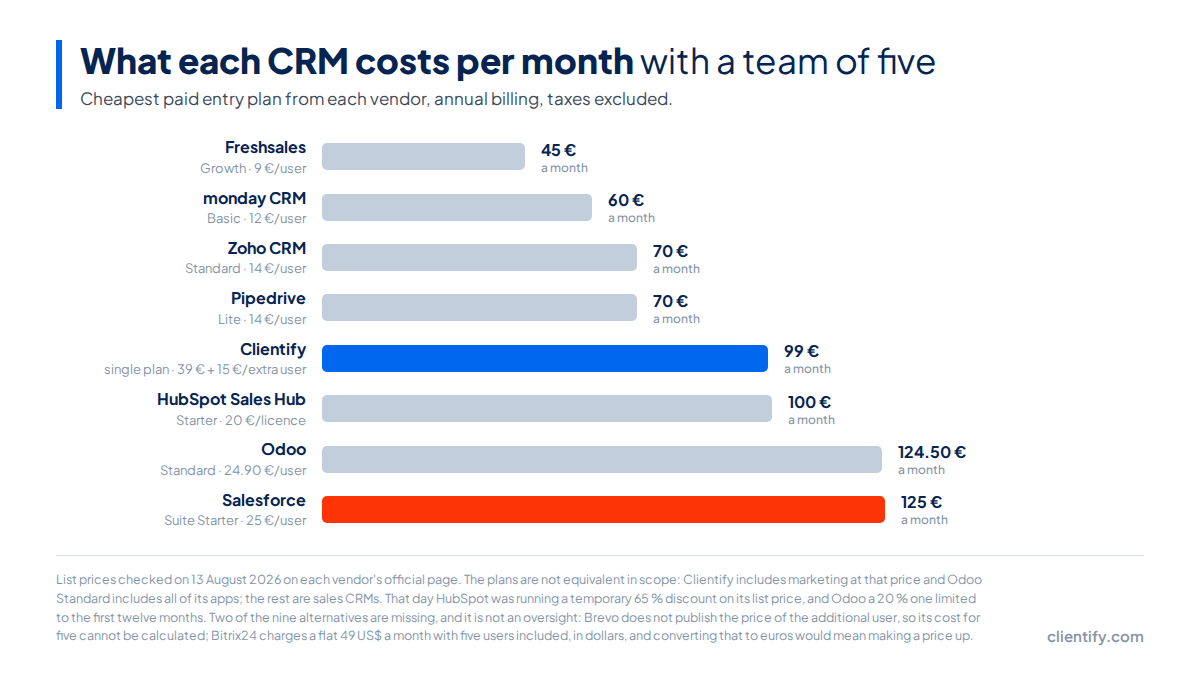
The main Salesforce alternatives for a small business are Freshsales, monday CRM, Zoho CRM, Pipedrive, Clientify, HubSpot Sales Hub, Odoo, Bitrix24 and Brevo. With a team of five people and annual billing, in August 2026 their entry plans ran from the 45 € a month of Freshsales to the 124.50 € of Odoo, against the 125 € of the Salesforce Suite Starter. Every price was read on the same day on each vendor’s own site and normalised to the same scenario. Below: the table, the nine profiles and when Salesforce is in fact the right choice.
Why do people look for a Salesforce alternative?
Because of the second tier. Salesforce comes in cheap, 25 € per user a month on its Suite Starter plan, and the problem is that the next plan costs 100 €. Not 20 % more: four times more, at the very first step.
It is the same mechanism as when you sign up for the promotional fibre rate and twelve months later the real bill arrives. You know the product is good, you know nobody misled you, but the number in front of you is no longer the one you decided to pay. And with a CRM that moment arrives sooner than it looks, because the entry plan has limits on features and on users that a growing company eats through in a couple of quarters.
| Plan | Price | Jump from the previous tier |
|---|---|---|
| Suite Starter | 25 € | Baseline |
| Pro Suite | 100 € | ×4 |
| Enterprise | 175 € | ×1.75 |
| Unlimited | 350 € | ×2 |
From there, three reasons come up again and again, and none of them is that Salesforce works badly:
- The real cost is not the licences, it is the implementation. Salesforce is built to be configured to fit, and configuring it to fit means a partner, a consultant or somebody on your team dedicated to it. If nobody in-house knows how, that invoice exists even though it never appears on the pricing page.
- It is over-dimensioned for a team of five. That is not a flaw: the tool is designed for sales processes a small business does not have. You pay for capacity you are not going to use.
- Spanish and Latin American operations are a separate matter: WhatsApp as a sales channel, e-invoicing, support in your language and in your time zone. On a global platform that gets solved with third-party integrations, and every integration is one more contract.
If you have arrived from another comparison, we follow the same criteria here as in the alternatives to HubSpot: prices from official sources with a date, and no tool disqualified for marketing reasons.
How much does each Salesforce alternative cost a month?
With five users and annual billing, between the cheapest option and Salesforce there are 80 € a month for the same team. Freshsales comes to 45 €, monday CRM to 60 €, Zoho CRM and Pipedrive to 70 €, Clientify to 99 €, HubSpot Sales Hub to 100 € list price, Odoo to 124.50 € and Salesforce to 125 €.
| Tool | Entry plan | Published price | How it charges | Monthly cost with 5 users |
|---|---|---|---|---|
| Freshsales | Growth | 9 € per user a month | Per user | 45 € |
| Bitrix24 | Basic | 49 US$ a month per company, 5 users included | Flat rate per company | 49 US$ (in dollars) |
| monday CRM | Basic | 12 € per user a month (18 € if you pay month to month) | Per user | 60 € |
| Zoho CRM | Standard | 14 € per user a month | Per user | 70 € |
| Pipedrive | Lite | 14 € per user a month | Per user | 70 € |
| Clientify | Single plan | 39 € a month with 1 user included, + 15 € per extra user | Base plan + seats | 99 € |
| HubSpot Sales Hub | Starter | 20 € a month per licence (with a 65 % temporary discount running that day) | Per licence | 100 € |
| Odoo | Standard | 24.90 € per user a month (19.90 € for the first 12 months) | Per user | 124.50 € |
| Salesforce | Suite Starter | 25 € per user a month | Per user | 125 € |
| Brevo | Sales Essentials | 26.08 € a month with 1 user included | Base plan + seats | Not calculable: it does not publish the price of the extra user |
Before you trust this table, or any other one, it is worth explaining why almost none of them add up.
Why CRM price comparisons never add up: not everyone charges for the same thing. Zoho, Pipedrive, Salesforce, Freshsales, monday and Odoo charge per user; HubSpot charges per licence; Clientify and Brevo have a base plan with one user included and charge for the rest separately; Bitrix24 charges a flat rate per company with a user cap inside it, so going from one user to five does not move its bill. Multiplying by five a price that is not per user gives you a number that does not exist, and that is exactly what most of the tables you will find searching for this do.
There is a second detail that third-party tables tend to hide: temporary discounts. On the day we checked, HubSpot was showing a 65 % discount on its Starter and Odoo a 20 % one valid “for 12 months, for the user licences initially purchased”. Both numbers are in the table, but the comparison uses the list price. Why? Because a promotion that expires within a year is no use for deciding which tool you are going to stay with for three. Hiding the discount would inflate a rival’s cost; using it to compare would tell you a story that ends on its own.
And then there is what you do not pay for.
Two of the nine have a genuine free plan, with small print. Odoo publishes “one app free” with unlimited users: if all you need is the CRM and one app is enough for you, that plan costs nothing. Bitrix24 has a plan that is “100 % free for 1-2 users” with 5 GB of storage and basic CRM. In both cases the limit is not the number of contacts but the scope: one app in Odoo, two people in Bitrix24.
How do you sign up for each one? Trial, discount and billing unit
They all publish an annual payment discount and they all offer a trial, but the small print changes quite a bit from one to the next. This table only collects what is printed on the pricing pages we checked: it does not compare features, because claiming a rival “has native WhatsApp” or “does not have it” would need a source per cell that we do not have today.
| Tool | Unit you pay for | Annual payment discount | Free trial |
|---|---|---|---|
| Freshsales | User | 20 % | 21 days |
| monday CRM | User (the selector on the site starts at 3) | 33 % | 14 days, no card |
| Zoho CRM | User | Up to 34 % | Yes, no card |
| Pipedrive | User | Yes (annual prices published; VAT not included) | Yes |
| Clientify | Base plan of 1 user + seats | 40 % (468 € a year) | 7 days, no card |
| HubSpot Sales Hub | Licence (Starter takes up to 5 paid users) | Yes, plus a 65 % temporary discount that day | Yes |
| Odoo | User | Yes, plus a 20 % discount limited to the first 12 months | Yes, and a free one-app plan |
| Salesforce | User | On Suite Starter the price is the same monthly or annually | Yes |
| Bitrix24 | Company, with users included | Up to 31 % | Yes, free plan for 1-2 users |
| Brevo | Base plan of 1 user + seats | 10 % | Yes, free plan |
Look at the monday figure: the selector on its site starts at three users. It is not that you cannot buy fewer, it is that the page is built assuming a team. And look at Salesforce, the only one in the comparison where paying up front saves you nothing on the entry plan: on Suite Starter the price is the same monthly or annually.
The nine Salesforce alternatives, one by one
Each profile carries the same things: entry price exactly as the vendor publishes it, how it charges and what is worth looking at before you sign. That last point is our editorial criteria, not a figure from the pricing page, and that is why it goes separately.
Freshsales
Growth, 9 € per user a month with annual billing, a 20 % discount against paying monthly and a 21-day trial, the longest in the comparison. It is the lowest entry price of the nine: five users come to 45 € a month, 25 € less than Zoho or Pipedrive and 80 € less than Salesforce.
What to look at: a low entry price almost always means the features you are going to need within a year sit in the next plan. Before deciding on the 9 €, look at what the tier above costs.
monday CRM
Basic, 12 € per user a month with annual billing. If you pay month to month it is 18 €: paying up front saves you exactly the 33 % its site advertises. A 14-day trial with no card. Five users, 60 € a month.
What to look at: monday CRM is a CRM layer on top of a project management tool, and that shows for better and for worse. If your team already lives in monday, adoption is immediate; if it does not, you are buying a product that does more things than you went looking for.
Zoho CRM
Standard, 14 € per user a month with annual billing and discounts of up to 34 % for paying annually. Trial with no card. Five users, 70 € a month. Its tiers (14 €, 23 €, 40 € and 52 €) climb far more gently than the Salesforce ones: from the first to the second there is a 64 % rise, not a ×4.
What to look at: the Zoho catalogue is enormous and the CRM is only one piece of it. The bill grows by adding apps, not by jumping plan.
Pipedrive
Lite, 14 € per user a month with annual billing, VAT not included, which its own page says in as many words. Five users, 70 € a month. Tiers of 14 €, 39 €, 59 € and 79 €.
What to look at: Pipedrive is a pure sales CRM and it is well built as one. If what you need is marketing, forms or campaign automation, you are going to end up buying another tool and paying two subscriptions.
Clientify
A single plan of 39 € a month with one user included and 15 € for each extra user, with annual billing (468 € a year, a 40 % discount) and a 7-day trial with no card. Five users come to 99 € a month.
And here it is worth saying the obvious: four of the nine alternatives are cheaper than Clientify with five users. Freshsales, monday CRM, Zoho CRM and Pipedrive. Add Odoo’s free one-app plan and Bitrix24’s plan for up to two users and the list of cheaper options grows. If your decision criterion is the price per seat and nothing else, we are not your option.
The argument is a different one: what is inside that price. Our pricing page lists as included the CRM with automations and e-signature, professional WhatsApp with a multi-user inbox, forms, landing pages, chatbots and quotes, unlimited sales contacts and 1,000 marketing contacts, e-invoicing with automatic registration in VeriFactu (available in Spain only) and support 100 % in Spanish. Bought separately, that is three or four subscriptions.
What to look at: if you already have a marketing tool that works and you are not going to touch it, you are paying for a part of the product you will not use. In that case a pure sales CRM works out better for you.
HubSpot Sales Hub
Starter, 20 € a month per licence list price, with annual billing; on the day we checked there was a 65 % offer running. Five licences, 100 € a month at list price. Starter takes up to five paid users.
What to look at: the same thing as with Salesforce, the second tier. HubSpot charges per licence and per tool, and the bill of a small business that keeps adding Hubs stops looking like the 20 € of the beginning very quickly. We go into it in the comparison of HubSpot alternatives.
Odoo
Standard, 24.90 € per user a month list price, with 19.90 € for the first twelve months on the licences bought at the start. Five users, 124.50 € a month. Watch out for one important thing: Odoo Standard is not a CRM plan, it includes all of its apps. Putting it next to Pipedrive Lite without saying so would be comparing different things.
What to look at: its free single-app plan with unlimited users is by some distance the most interesting option in the comparison if one app really is enough for you. The trade-off is that Odoo is an ERP: the power comes with a configuration curve.
Bitrix24
Basic, 49 US$ a month per company with five users included, annual billing, with discounts of up to 31 %. It publishes in dollars on its Spanish site too, so it goes into the table in dollars: converting it to euros at any given day’s exchange rate would invent a price nobody has published. Its free plan covers one or two users with 5 GB and basic CRM.
What to look at: it is the only one charging a flat rate per company, so going from one user to five does not move its bill. If your sales team is going to grow fast, that model plays in your favour.
Brevo
Sales Essentials, 26.08 € a month with one user included, with a 10 % discount for paying annually and a free plan available. It is the only one of the nine missing from the five-user comparison, and that is not an oversight: its page does not publish the price of the extra user, so the cost of a team of five cannot be worked out. Multiplying 26.08 by five would give a number that does not exist.
What to look at: Brevo comes from email marketing and its CRM is an extension of that. If your heavy volume is campaigns and the pipeline is secondary, it fits; the other way round, less so.
When does it make sense to stay on Salesforce?
When at least one of these four conditions is true. And none of them carries a “but” behind it:
- You are going to go past fifty users. At that scale, administering permissions, territories and hierarchies stops being a luxury and becomes the main problem. Salesforce has spent twenty years solving exactly that.
- You have an in-house technical team or a partner. If somebody knows how to configure it, hardly anyone matches Salesforce for adaptability. Without that person, the same adaptability turns into a never-ending project.
- There is an implementation budget separate from the licences. “The head of sales will do it in their spare time” does not count as a budget.
- Your sales process falls outside the standard: territory selling with complex rules, chained approvals, forecasting by product line. If the process does not fit into a pipeline with stages, you need a tool that bends.
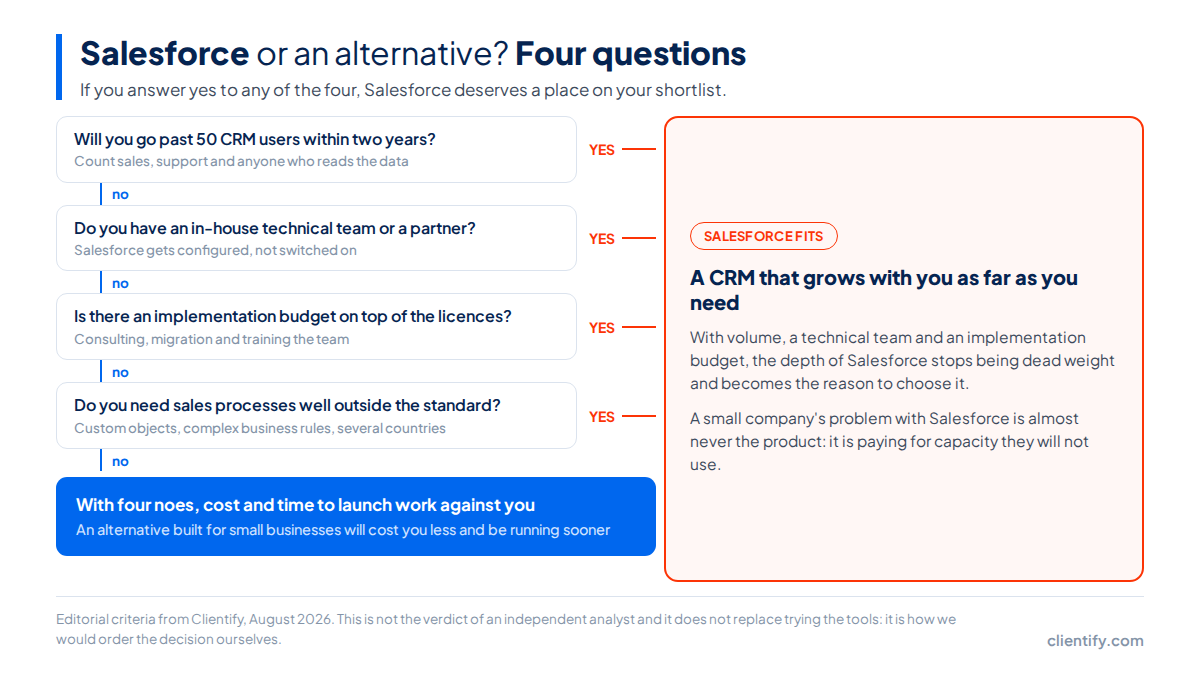
If none of the four describes you, what you are buying is spare capacity. And spare capacity in software gets paid for every month. If you want the head-to-head with ours, we have it in the Clientify vs Salesforce comparison.
How do you migrate from Salesforce to another CRM without losing data?
By exporting as CSV from Salesforce and importing in a specific order, because each entity hooks onto the previous one:
- Companies. First, always. They are the anchor for the rest.
- Contacts, already linked to their company.
- Deals, linked to contact and company, with their amount, stage and close date.
- Activities: calls, notes, emails and tasks.
Before you export anything, two decisions that save weeks. The first: clean up duplicates at source. Migrating a duplicate does not fix it, it reproduces it somewhere new, and the step by step for unifying contacts is the same one you would apply afterwards. The second: decide which custom fields you really keep. In a Salesforce with years of use there are fields created by somebody who no longer works there and that nobody has filled in since 2023. That is the moment to let them go.
After importing, check three things before you call the migration good: that the number of records matches the export, that the open deals add up to the same total amount, and that owner assignments are correct. If something breaks, it breaks there.
The mechanism is the same one we explain in the guide on leaving Excel behind for a CRM, with one difference in your favour: Salesforce data is already structured and already has relationships. The hard part of that guide, you have already done.
So which one do you go with?
It depends on what you are solving, and by this point in the article you have what you need to decide:
- If you want the cheapest possible pipeline, Freshsales at 9 € and monday CRM at 12 € per user open the list.
- If the CRM is all you need and you accept configuring it, Odoo’s free single-app plan, with unlimited users, has no rival on price.
- If your team is going to grow, the Bitrix24 flat rate per company changes the arithmetic.
- If you sell on WhatsApp, look at who brings that in as standard and who solves it for you with third-party integrations: the comparison of CRM with WhatsApp goes into it.
- If what you want is to stop paying for four subscriptions, that is where we come in, knowing that we are not the cheapest per seat.
And if the choice matters less to you than getting it live, everything that goes into implementing a CRM in a small business is a better next read than another comparison table.
What is the best Salesforce alternative for a small business?
It depends on what you need to solve. If you only want a tidy, cheap sales pipeline, Freshsales, monday CRM, Zoho CRM and Pipedrive start between 9 and 14 € per user a month. If you also need marketing, WhatsApp and invoicing in the same tool, the comparison changes and all-in-one platforms like Clientify come in.
How much does Salesforce cost a month?
The entry plan, Suite Starter, costs 25 € per user a month according to the official Salesforce site checked in August 2026. The next plan up, Pro Suite, jumps to 100 € per user a month: it quadruples the price at the first step, which is where many small companies rethink the tool.
Is Salesforce worth it for a small company?
Yes, in specific scenarios: if you are going to go past fifty users, if you have a technical team or a partner to configure it, and if there is an implementation budget separate from the licences. Without those three conditions, the usual outcome is paying for capacity you never get to use.
Which CRM is cheaper than Salesforce?
With five users and annual billing, in August 2026 these came in below the Salesforce Suite Starter, which costs 125 € a month: Freshsales Growth at 45 €, monday CRM Basic at 60 €, Zoho CRM Standard and Pipedrive Lite at 70 €, Clientify at 99 € and HubSpot Sales Hub Starter at 100 € list price.
How do I migrate my data from Salesforce to another CRM?
By exporting from Salesforce as CSV and importing in this order: companies first, then contacts, then deals and finally activities. That order matters because each entity hooks onto the previous one. Before migrating it pays to clean up duplicates and decide which custom fields you are really going to keep.
Try an alternative before you renew licences
7 days free, no card. Set up your pipeline, import your contacts and check it with your own data, not with the data in a comparison table.
Try Clientify free