


First, the declaration of interest: Clientify writes this and Clientify is on the list. We are saying it in the first line so you know where you are reading from.
That said, here are the six: monday CRM, Pipedrive, Zoho CRM, HubSpot, Bitrix24 and Clientify. Each rate was read on the vendor’s own site on 2 September 2026, with annual billing and taxes excluded. If you are after the lowest per-seat price, monday CRM and Pipedrive win. If what you want is to stop paying for three separate tools, the maths changes. And if your problem is not selling but coordinating work, none of the six is your answer: keep reading the first section.
Are you looking for a monday alternative for projects or for selling?
There are two different mondays and almost no comparison says so.
If you have more than one team working inside, you have probably seen it: on the operations board the columns are “owner”, “due date” and “status”, and on the sales board someone hand-built a column called “company”, another called “amount” and a third called “stage” that is really a coloured dropdown only its creator understands. Both boards live in the same account. They are not the same product.
monday Work Management exists to coordinate work: tasks, owners, dates, dependencies, team workload. Your smallest unit is the task. monday CRM exists to sell: contacts, companies, deals, a pipeline by stage. Your smallest unit is the customer — which is, in short, what a CRM is for.
This is not a textbook distinction. It decides which list of alternatives is any use to you. If you are leaving Work Management, your candidates are Asana, ClickUp, Trello or Notion, and no CRM is going to fix anything for you however cheap it comes in. If you are leaving monday CRM, your candidates are the six in this article.
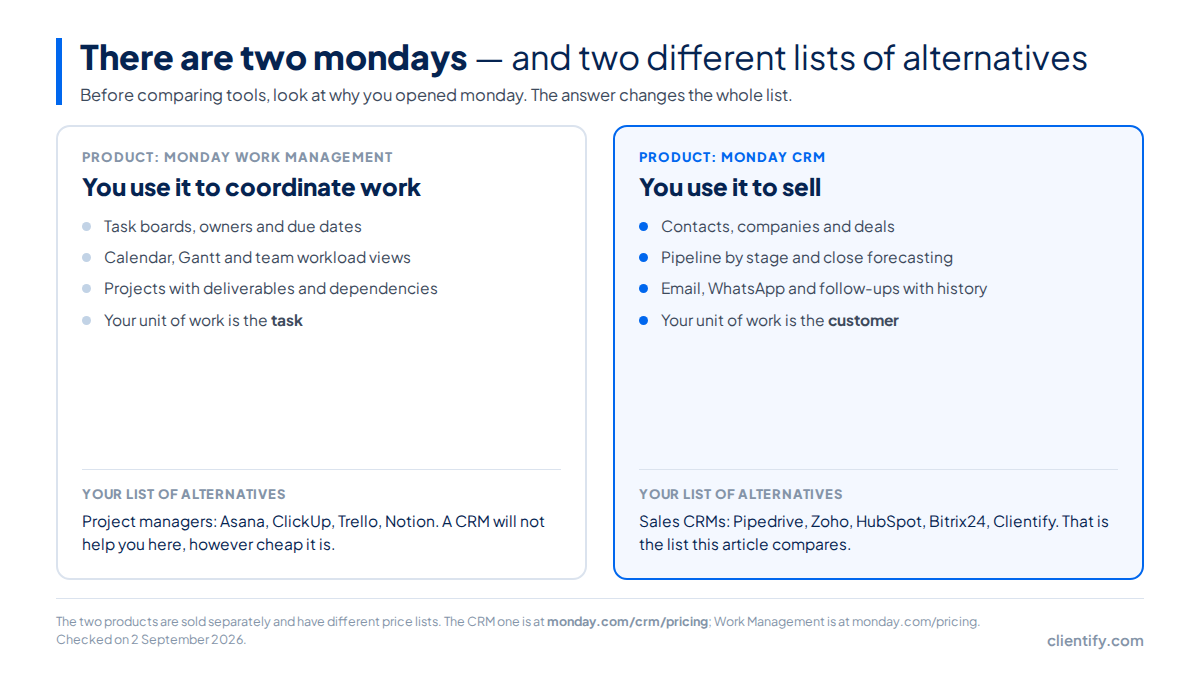
| If you opened monday to… | Your unit of work is… | The product you use | Where to look for an alternative |
|---|---|---|---|
| Hand out tasks, see who is running late and run projects with deadlines | The task | monday Work Management | Project managers: Asana, ClickUp, Trello, Notion. A CRM will not help you. |
| Store contacts, move deals through a pipeline and follow up on sales | The customer | monday CRM | Sales CRMs. That is the list this article compares. |
| Both at once, on boards that mix the two | Depends on the day | Usually Work Management with improvised columns | First decide which of the two is costing you money. That is the one you replace. |
Careful with the price lists. The two products are sold separately and cost different amounts. The CRM one is at monday.com/crm/pricing; Work Management is at monday.com/pricing. The address monday.com/pricing/crm, quoted in quite a few comparisons, returns a 404. Checked on 2 September 2026.
If the table leaves you unsure, there is a shortcut: look at what is costing you money. If what is falling through is deliveries and deadlines, it is a projects problem. If what is falling through is follow-ups, quotes nobody remembers and customers going cold, it is a CRM problem. Almost nobody has both with the same urgency.
How much does monday CRM cost in euros?
This is where it pays to slow down, because the price doing the rounds is often not the CRM’s.
With annual billing, monday CRM Basic costs €12 per seat per month; Standard, €17; Pro, €28. If you pay month to month instead of annually, those same plans go up to €18, €25 and €41 per seat. The Ultimate plan publishes no price: you have to ask. All of that read on monday.com/crm/pricing on 2 September 2026, taxes excluded.
Two warnings that are worth money.
The first is about free, and it is that the CRM price list includes no plan of that kind. There is a trial with no card, and from there you move to Basic. The Free plan many people remember seeing is monday Work Management’s, which is a different product with a different price list. It is the most repeated confusion when someone compares monday prices, and it is understandable: they share a brand, a website and a look.
The second is a question of web address, and it is worth looking at carefully. The right price list is at monday.com/crm/pricing. The one quoted in quite a few comparisons, monday.com/pricing/crm, with the last two words swapped, returns a 404. If you have read a monday CRM price in an article that linked there, that price did not come from the price list.
And a quick sum to keep in mind for the rest of the article: five people on Basic, paying annually, is €720 a year. It is the lowest number in this whole comparison.
How was this comparison made?
Before the list, the method. It is boring and it is the part that lets you trust the rest.
One. Every price was read on the vendor’s own site on 2 September 2026, not on an aggregator or a third party’s blog. Each card links to the price list so you can check it yourself. There is one exception and it is declared where it applies: Pipedrive’s pricing page returned Cloudflare’s anti-bot screen on both attempts today, so its figures come from our 31 August 2026 reading, in euros and on the same annual-billing basis.
Two. All rates are with annual billing and taxes excluded, which is how almost the whole sector publishes them. If you are going to pay month to month it will cost you more, and quite a lot more: in monday CRM, to take the case at hand, the three paid plans rise between 46% and 50%.
Three. When a price cannot be checked, we say so. It is not estimated, not copied from another site and not converted from another currency at the day’s rate. You will see a concrete case in the Bitrix24 card, and it is why its cell in the table is hatched instead of holding a number.
Four. There is no quality ranking. The tools are not ordered from best to worst because “best” depends on what you need, and anyone telling you otherwise has an affiliate link behind them. They are ordered by entry price.
Five. Clientify is on the list and does not get a longer card than the others, nor a shorter one, because we are not going to fake a modesty we do not have. It simply does not take up more space than the other five.
The 6 alternatives to monday CRM in 2026
| Tool | Entry plan | Published price | 12 months with 5 people | Trial | What sets it apart |
|---|---|---|---|---|---|
| Clientify | Starter plan | €39/month +€15/month per extra user |
€1,188 | Yes, no card | CRM, marketing and WhatsApp in the same account. The price is not multiplied per user: it grows in steps of 15. |
| monday CRM | Basic | €12/seat/month annual · €18 a month rolling |
€720 | 14 days, no card | The cheapest on the list and the one you already know. The boards are the same ones as in Work Management. |
| Pipedrive | Lite | €14/seat/month annual · read 31 Aug 2026 |
€840 | 14 days | The best-resolved visual pipeline on the market. Marketing and automation sit in higher plans. |
| Zoho CRM | Standard | €14/user/month annual |
€840 | Free for up to 3 users | A huge catalogue of connected apps. The deeper you go, the more setup it takes. |
| HubSpot | Starter Customer Platform | €20/month annual · list price |
€1,200 | Free plan | The most complete suite and the one that climbs fastest as you scale: Professional starts at €60 a month. |
| Bitrix24 | Basic | US$ 49/month flat rate, 5 users included |
Charges in dollars | Free plan (1-2 users) | The company pays, not the seat. With big teams it is unbeatable on price; the interface is heavy. |
Every rate was read on each vendor’s own site on 2 September 2026, with annual billing and taxes excluded. The 12-month column is the entry plan for five people. These are not equivalent plans: monday CRM Basic, Pipedrive Lite and Zoho Standard are sales CRMs; Clientify’s starter plan also includes marketing and WhatsApp. For Bitrix24 we publish no euro figure because there isn’t one: its site bills in dollars, and converting at one particular day’s exchange rate would mean inventing a price nobody charges. Pipedrive is the exception on the date: its pricing page blocked our reading today, so its figures come from the 31 August 2026 reading, in euros and on the same annual-billing basis.
The cheapest per seat, and the one you already know
Let’s start with the one you are thinking of leaving, because staying is also an option and it needs a price on it. monday CRM comes in at €12 a seat per month on annual billing — that is what its price list says — and it is the lowest figure in the table. In exchange you get what you already know: boards that make sense without a manual, configurable views, and a team that probably already knows its way around, which is no small advantage.
Where does Basic pinch? On the caps, which its own price list publishes without dressing up: 1,000 active contacts and deals, a single dashboard, a maximum of five columns per board and twenty quotes or invoices a month. Mass email and sequences do come in from Basic, and that has to be said. What does not appear with a number is automation: Basic mentions it with no figure, Standard publishes 250 actions a month and Pro jumps to 25,000. When you start automating seriously, that is the step that moves you up a plan.
The real limitation is more fundamental: monday CRM is still a board with sales vocabulary bolted on. It works very well as long as your process fits in columns. When you need serious close forecasting or attribution of where each lead came from, it falls short.
One detail that catches out anyone working alone: monday CRM is sold from three users. If you are a freelancer or there are two of you, the real entry price is not €12, it is €36 a month, even with the third seat empty.
Verdict: if your team already lives in monday and the CRM is a small piece of the whole, switching will cost you more than it saves you.
The best-resolved pipeline on the market
There is a category of product that does one thing and does it better than anyone, and Pipedrive is the CRM example. Its Lite plan costs €14 per seat per month on annual billing, and from there it goes to Growth (€39), Premium (€59) and Ultimate (€79). The trial is 14 days. Those figures come from our reading of Pipedrive’s European price list on 31 August 2026: today its pricing page would not open for us, and we would rather tell you the date than pretend it was this morning.
What you buy is a visual pipeline in which any sales rep understands in five seconds what they have to do today. You drag the card, the stage changes, the follow-up schedules itself. If your problem is that deals go cold because nobody knows which one is next, this solves it on day one.
What you pay for separately is practically everything else. Email marketing is a module with its own cost, and the powerful automation features start at Growth, almost triple Lite. The twelve-month sum with five people comes to €840 on the entry plan, but if you need real automation you are looking at €2,340.
Verdict: the best one if you sell with a clear process and do not need marketing inside.
The endless catalogue, with the good and the bad that brings
When someone has spent decades making business software, they end up with an application for everything. Zoho CRM comes in at €14 per user per month on Standard, and continues with Professional (€23), Enterprise (€40, the one its own site marks as most popular) and Ultimate (€52). Its price list also announces that it is free for up to three users.
Its advantage is the ecosystem: accounting, e-signature, support, HR, campaigns. All connected and all on the same invoice if you go into Zoho One. For a company that wants a single house for everything, it is a very serious option and a very underrated one.
Its problem is born right there, because every deep feature demands configuration, and configuration demands someone to do it. The interface carries years of accumulation, and the jump from Standard to Enterprise is where most of the things people take for granted live, such as lead scoring or approval processes.
Verdict: excellent features-to-price ratio if you have someone willing to set it up. A small hell if you expected to open it and sell on Tuesday.
The complete suite and the climb that comes after
HubSpot’s entry plan is €20 a month list price on its Starter Customer Platform, with annual billing, as shown on its pricing page. And two things need saying about that figure. The first is that there is a genuinely free plan, with a basic CRM, that plenty of people use for years without paying anything. The second is that on the day we read the site there was a 65% promotion leaving Starter at €7, with no declared end date. Here we publish the list price, because an offer with no known expiry is not a rate.
What you buy is the most rounded suite on the market: marketing, sales, service and CMS genuinely talking to each other, with the best documentation in this sector.
What hurts comes later. Professional starts at €60 a month and Enterprise at €90 per licence, and that is where the serious workflows live. The jump from Starter to Professional is the moment many SMBs discover their CRM costs four times what it did last year. If you are weighing that jump, we did the maths in the best alternatives to HubSpot.
Verdict: unbeatable if you are going to grow a lot and have the budget to go with that growth.
The one that charges per company, not per seat
Here is the odd case of the comparison, and also the most interesting one if you have a big team. Bitrix24 does not charge per user: it charges a flat rate per company. On its price list, Basic is 49 dollars a month with five users included; Standard, 99 with fifty; Professional, 199 with a hundred. There is a free plan for one or two users.
Do the maths with twenty people and you will see why it is on this list: where the others multiply, Bitrix24 does not move. It also bundles in things the others sell separately, such as telephony, an intranet and task management.
And now the asterisk, which is a big one. Its site bills in dollars. We went into bitrix24.com/prices/ and there is not one euro amount: the whole price list is in US$. We have not converted it, and we are not going to: one particular Tuesday’s exchange rate is a photograph of that Tuesday, not a rate. If you sign up, ask which currency they will bill you in and what commission your bank charges you.
The other drawback is the density. Bitrix24 does so many things that the first week is overwhelming.
Verdict: by far the cheapest option if there are more than ten of you, as long as you accept the currency and the learning curve.
The one that puts the CRM together with what you pay for separately today
Our turn. The Clientify starter plan costs €39 a month with one user included, and each extra user adds €15 a month. With five people that is €99 a month, €1,188 a year. The trial is free and asks for no card.
Let’s go with what we are not, which saves time. We are not the cheapest in this table, because monday CRM and Pipedrive come in below us, and we are not a project manager. If you need Gantt charts and dependencies between tasks, monday Work Management does it better and we are telling you so here, in our own article.
What Clientify does solve is one specific case: the team with the CRM in one place, email marketing in another, WhatsApp on a sales rep’s phone — we break that case down in which CRM to connect to WhatsApp — and the website forms in a third. That comes in the same account from the starter plan. And the price is not multiplied per seat, it grows in fifteen-euro steps, which starts to show from the fourth user.
The honest limitation is simple. If all you want is a sales pipeline and nothing else, you are paying for a marketing side you are not going to open.
Verdict: worth it when the saving is in cancelling two subscriptions, not in the CRM.
What will you really pay over 12 months?
Per-seat pricing misleads because each tool counts a seat its own way. So the only sum that is any use has three fixed conditions: entry plan, five people, twelve months.
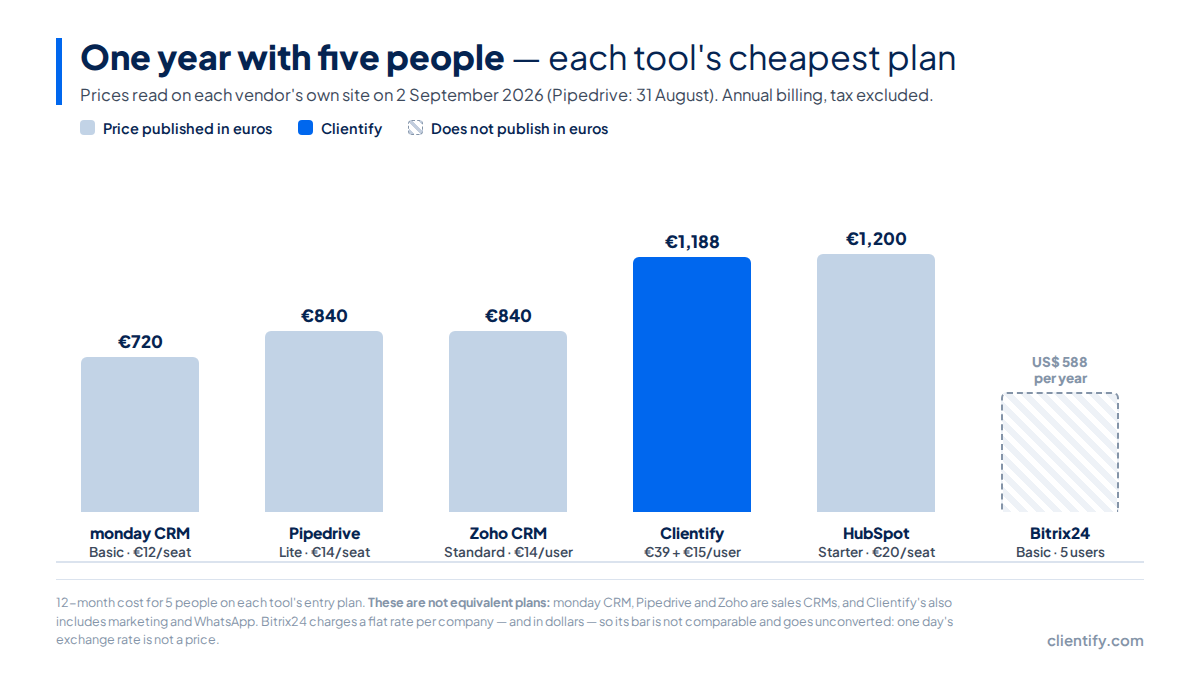
The numbers, in order: monday CRM €720, Pipedrive €840, Zoho CRM €840, Clientify €1,188, HubSpot €1,200 list price. Bitrix24 gets no euro bar for the reason already explained.
And now the small print, which is what actually decides.
Those five figures do not buy the same thing. For €720 you get a CRM. For €1,188 you get a CRM plus email marketing plus WhatsApp. If you pay for a separate email tool today, add its annual invoice to the left-hand column before comparing, because otherwise you are comparing one thing with another.
The second point is how each one grows. With ten people instead of five, monday Basic goes from €720 to €1,440, Pipedrive Lite from €840 to €1,680 and Clientify from €1,188 to €2,088. The per-seat ones double; ours rises 76%, because only the user part is multiplied. The gap widens as people come in, and that is why the sum has to be done with the team you will have in a year, not today’s.
When does it suit you to stay on monday?
This part is serious, and it is the one you probably will not read in another comparison written by a competitor.
Stay if your team already lives inside the boards. If operations, product and support work in monday and sales is one more tab, pulling out only the CRM leaves you with two tools where there was one. The cost of that appears on no pricing table and it is real: people asking where the thing they were looking for went.
Stay if you need real project management. Dependencies between tasks, team workload view, timelines with milestones. monday does that very well and none of the six CRMs on this list replaces it. Not ours either.
Stay if €12 a seat is what there is. If the budget is closed and the team is small, monday CRM Basic is the cheapest entry in the comparison. Paying more for features you will not open in six months looks a lot like spending.
And stay if nobody is going to lead the change. A new CRM with no one to set it up, load the data and chase the team for the first few weeks ends up exactly like the spreadsheet you came from: abandoned, but more expensive.
Switch when the opposite happens: when the invoice for the separate tools already beats the CRM’s, when you need to know where each lead came from, or when the sales team has started keeping its own parallel spreadsheet because the board is no use to them. That last signal is the most reliable of all.
How do you choose yours?
Seven checks before you sign anything. They take an afternoon and they save you a year.
- Open monday and look at which column you actually use. If it is “owner” and “due date”, your problem is projects. If it is “company”, “amount” and “stage”, it is sales. Switching tools before answering this just moves the same mess somewhere else.
- Count the people who will come in, not the ones in there today. Almost everyone charges per seat, so the price that looks good at three users is a different price at ten. Do the maths with the team you will have a year from now.
- Add up what you pay for separately today. The email tool, the WhatsApp one, the forms one, the e-signature one. If any of those is included in the new CRM, the price is not only being compared against monday.
- Export before you decide. Ask for a full export of your boards and open it. Whatever is not in that file will not migrate on its own, and you are much better off finding that out now than on the day of the switch.
- Check the language of support and its hours. With a billing problem at nine in the morning in Madrid, English-only support on California hours is a different entry plan from the one you bought.
- See whether the entry plan has automations or they are an add-on. This is where most people get an unpleasant surprise: the CRM comes in cheap and the part you were going to use every day sits two plans higher.
- Test with real data, not with the signup sample. Put in twenty of your own contacts and one real deal. Half an hour of that tells you more than two weeks of reading comparisons. That one is included.
One final recommendation on the order: do the free trial last, not first. Once you are clear on what you need and how much you are willing to pay, half an hour of product confirms or kills the decision. The other way round, all you manage is to try four tools, like all of them, and stay where you were.
What Clientify is doing on this list
Let’s start with what it does not do. Clientify is not a project manager: if what you need is a Gantt chart, dependencies between tasks and team workload, you will not find it here and monday Work Management does it better. It is not the cheapest CRM in the table either — monday CRM comes in at €12 a seat and we come in at €39 for the plan — and we are writing that down because the chart above shows it anyway.
What it does solve is one specific case: the team that left monday because it had the CRM in one place, email in another, WhatsApp on a sales rep’s phone and the website forms in a third. Clientify puts that in one account, with a price that grows in fifteen-euro steps per user instead of multiplying the whole plan.
Frequently asked questions
What is the best alternative to monday CRM?
There isn’t one: it depends on where the price hurts. If you want the lowest per-seat cost, Pipedrive Lite and Zoho Standard start at 14 euros a month. If you want CRM, marketing and WhatsApp in the same account, Clientify starts at 39 euros monthly with one user included.
How much does monday CRM cost per month?
The Basic plan of monday CRM costs 12 euros per seat per month billed annually, or 18 euros a month if you pay month to month. Standard goes up to 17 euros and Pro to 28, always per seat. Rates read on monday.com/crm/pricing on 2 September 2026.
Does monday CRM have a free plan?
The monday CRM price list does not include any free plan: it offers a 14-day trial with no card and moves straight to Basic. There is a Free plan in monday Work Management, which is a different product with a different price list. That is the most common confusion when comparing monday prices.
What is the difference between monday CRM and monday Work Management?
Work Management is for coordinating work: tasks, owners, dates and projects. monday CRM is for selling: contacts, companies, deals and a pipeline by stage. They are sold separately, they cost different amounts and each one leads to its own list of reasonable alternatives.
Can I take my data from monday to another CRM?
Yes. Before signing anything, export your boards from monday and open the file: it is the only way to see what actually travels. Contacts, companies and deals usually move without trouble. What almost never survives intact are the automations, the custom views and the attached files.
When does it make sense to stay on monday?
When your team already lives inside the boards and the CRM is a small part of what you do there. Also if you need real project management, with dependencies and team workload: monday does that well and no CRM in this comparison replaces it.
Do the maths with your team, not with ours
Free trial, no credit card. Put in twenty real contacts and one deal
you actually have open: half an hour tells you whether this works for you.